Space and Physics
 PUBLISHED



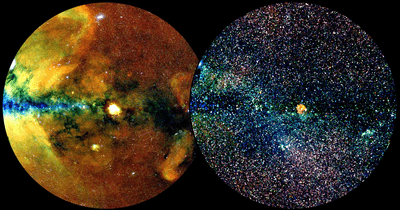


Behold the X-ray sky as you have never seen it before. The space telescope eROSITA has been observing the sky for several years and researchers have now published the map of half of the sky. It is the largest map of high-energy sources ever created.
The data was collected between December 2019 and June 2020 and it detected over 900,000 unique sources. Of those, 710,000 sources are supermassive black holes in other galaxies. There are 180,000 X-rays emitting stars from our own as well as 12,000 galaxy clusters, and many exotic objects emitting high-energy light, including the Vela pulsar – brightly visible at the center of this map.
“These are mind-blowing numbers for X-ray astronomy,” Andrea Merloni, eROSITA principal investigator and first author of the eROSITA catalogue paper, said in a statement. “We’ve detected more sources in six months than the big flagship missions XMM-Newton and Chandra have done in nearly 25 years of operation.”
The eROSITA collaboration has so far published 200 papers and with the release of this impressive catalog, they have submitted for peer-review 50 more. There are newly discovered filaments between galaxy clusters, black holes erupting quasi-periodically, and much more. Another very interesting study highlights the discovery of over 1,000 superclusters of galaxies. The wealth of data and discoveries is truly unprecedented in X-ray astronomy.
“The scientific breadth and impact of the survey is quite overwhelming; it’s hard to put into a few words,” added Mara Salvato, who as a spokesperson for the German eROSITA consortium coordinates the efforts of about 250 scientists. “But the papers published by the team will speak for themselves.”
“The eROSITA collaboration has done an outstanding job with the data release and at the same time publishing all of these amazing new results,” said Kirpal Nandra, Director at the Max-Planck Institute for Extraterrestrial Physics. “There’s a lot more to come from us, and we’re looking forward to seeing what the rest of the world will do with the public data.”
An important publication is expected to come in about two weeks. Among the goals of eROSITA is to better constrain cosmological models given the current uncertainties plaguing the leading model. The constraints that will be presented in the coming work are based on the galaxy clusters seen in this catalog.
We will certainly look forward to finding out more.