Space and Physics
 PUBLISHED
 3
3



![An area of deep space with thousands of galaxies in various shapes and sizes on a black background. Most are circles or ovals, with a few spirals. More distant galaxies are redder in colour and smaller, down to being mere dots, while closer galaxies are a bit larger and white or blueish. A few gold-coloured galaxies are bunched closely together in the centre. Bright stars surrounded by spikes lie in our galaxy.]](https://assets.iflscience.com/assets/articleNo/79025/aImg/83614/jwst-and-hubble-new-deep-field-s.jpg)


Look at this incredible view! Galaxies stretching over billions of years in a single small-but-mighty image from JWST with some assistance from the Hubble Space Telescope.
It is a small area of the sky, equivalent to holding a square of one millimeter by one millimeter at arm’s length. But tens of thousands of galaxies are visible in this patch, stretching for tens of billions of light-years.
Let’s look at the deep field in detail. Everything that has six bright spokes is a star in our galaxy. The true star of the image is a massive group of galaxies as it appeared when the universe was 6.5 billion years old. That is a little less than half the universe’s current age. That means its light traveled for 7 billion years to reach us, but the group is not just 7 billion light-years away. Due to the expansion of the cosmos, it is now much further away.
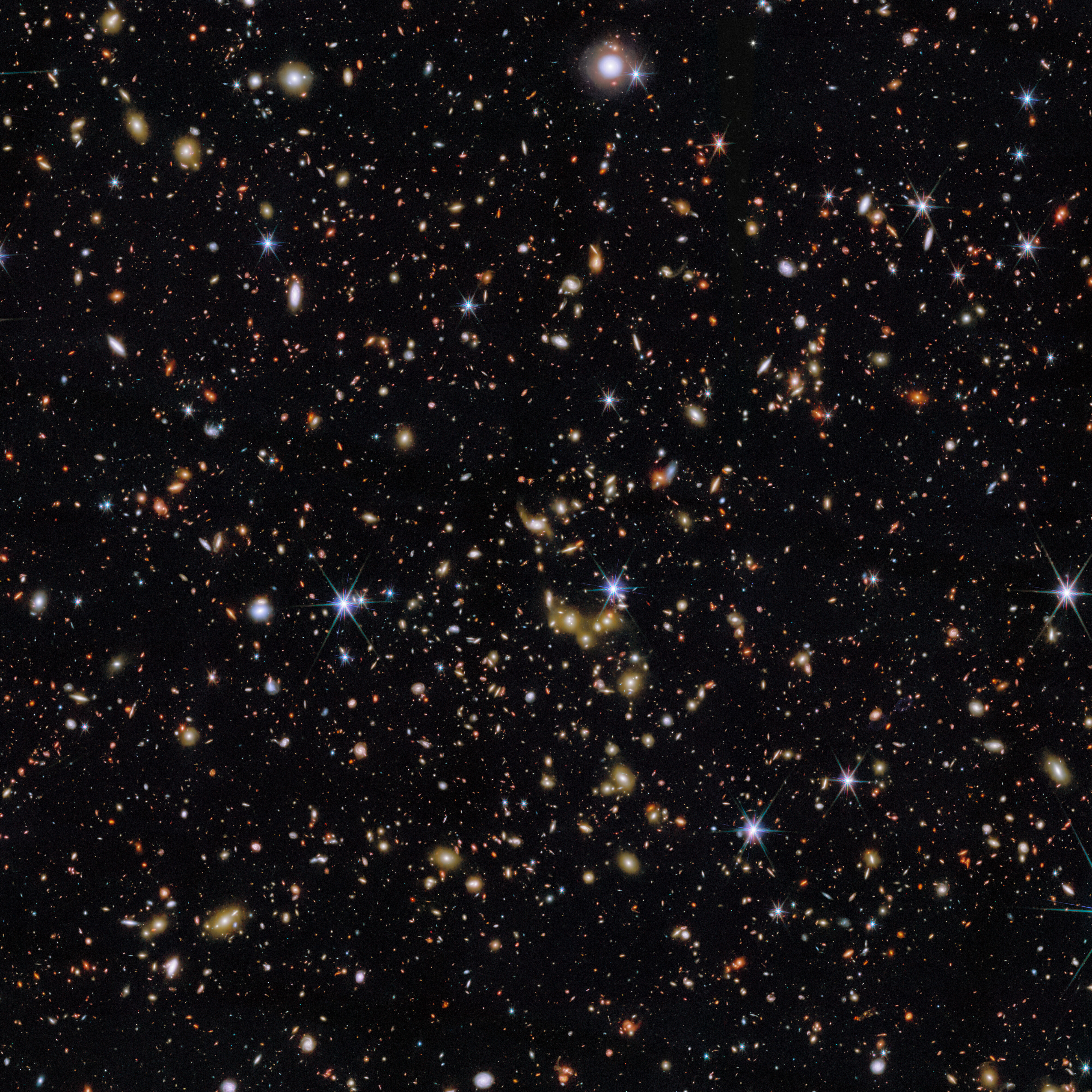
The image is part of the Cosmic Evolution Survey (COSMOS-Web) that looks at galaxies across many different ages of the universe. This main galaxy group is the most massive in the COSMOS-Web survey, but there are groups and galaxies in this image whose light comes to us from 1.9 billion years after the Big Bang – that’s just 14 percent of the universe's current age.
COSMOS-Web wants to provide new insights into the formation of the universe's most massive galaxies.