Space and Physics
 PUBLISHED
 1
1


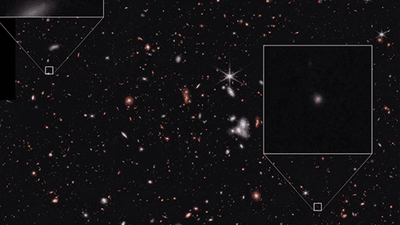


Astronomers looking at data from the JWST, humanity's most powerful space telescope, have found a number of objects in the distant universe so odd that they have been dubbed "platypus galaxies".
JWST has allowed astronomers to look back further into the past than any other infrared or optical telescope, seeing infrared light that was emitted by distant galaxies just 280 million years after the Big Bang. With the infrared telescope, we were hoping to learn more about the formation of galaxies, as well as clear up mysteries about how supermassive black holes became so large. But we have been thrown a few surprises as we look further back into the past.
One such surprise is the tiny, bright red points of light that appear to be dotted throughout the early universe, around 600-800 million years after its birth, which have come to be known as Little Red Dot (LRD) galaxies. When they were first detected and analyzed, astronomers believed they could be massive galaxies. But this was at odds with how cosmological models expect galaxies to form – as small clouds of dust and stars that grow larger over long periods of time.
The new team of astronomers from the University of Missouri was not interested in LRDs themselves, but their appearance in the JWST data got them thinking.
"It was the fact that a significant fraction of LRDs being point-like in the high-resolution JWST images inspired a simple question that we intended to address: are there any other new kinds of objects among point-like sources that we did not notice previously?" the team explains in their study, which has not yet been peer reviewed.
The team looked at 2,000 sources found in JWST surveys, whittling them down and identifying nine point-like sources in the early universe, 12 to 12.6 billion years in our past. Looking at these objects, which emitted their light when the universe was just over a billion years old, the team found they didn't fit neatly into any known category of space object.
"It seems that we’ve identified a population of galaxies that we can’t categorize, they are so odd. On the one hand they are extremely tiny and compact, like a point source, yet we do not see the characteristics of a quasar, an active supermassive black hole, which is what most distant point sources are,” principal investigator Haojing Yan said in a NASA press release.
"I looked at these characteristics and thought, this is like looking at a platypus. You think that these things should not exist together, but there it is right in front of you, and it’s undeniable."
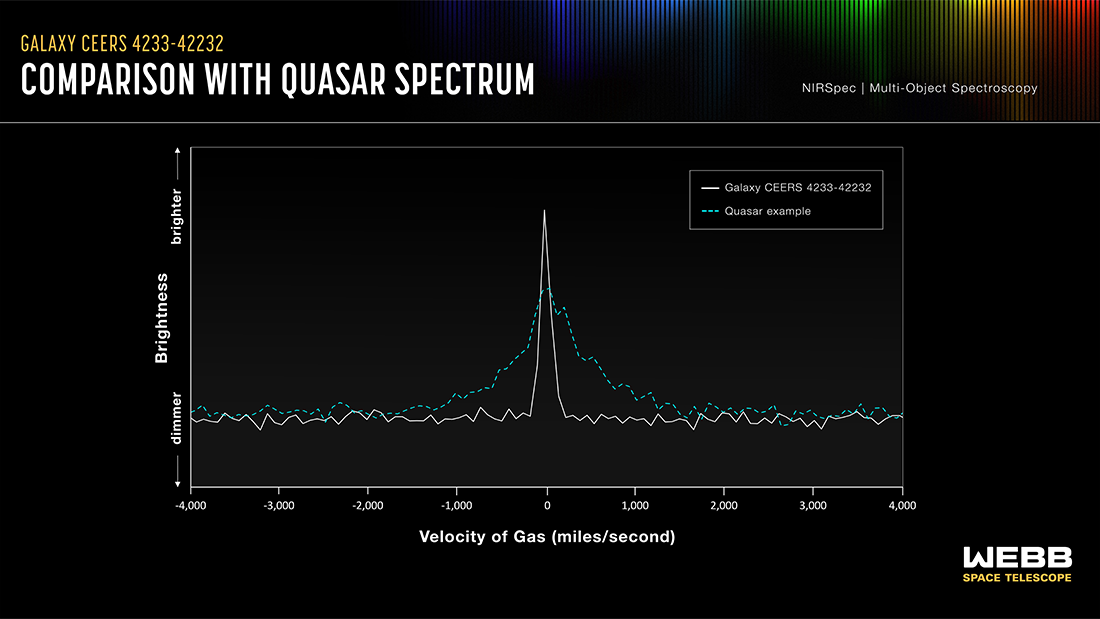
Spectral emission lines from quasars generally look like broad hills, which is the result of high velocity gas swirling around the supermassive black hole at the center. These "platypus" objects are point-like, like quasars, but their spectral emission lines look sharp and jagged.
The team compared the sources to another class of galaxies, but there were key differences here too.
"The closest resemblances to our objects are probably the so-called 'green pea' galaxies (GPs). GPs are compact galaxies at low redshifts (z ≲ 0.4) that have extremely strong emission lines, which make them green in the color composite of optical images," the team explained in their paper.
These galaxies have been found to have star-forming regions and active galactic nuclei.
"However, there are still notable differences that distinguish our objects from GPs," the team continues. "The most obvious one is that our objects are point-like but GPs are not. While GPs appear to be unresolved in ground-based images, those that have HST images all show that the GP regions are embedded in extended hosts, which often have complex morphologies indicative of mergers."
At the moment the team believes that the observations are consistent with seeing young galaxies ∼110–170 million years old. If that is the case, we could be looking at very early galaxy formation.
“I think this new research is presenting us with the question, how does the process of galaxy formation first begin?" Yan added. "Can such small, building-block galaxies be formed in a quiet way, before chaotic mergers begin, as their point-like appearance suggests?”
"If they are confirmed to be SF [star-forming] galaxies, they likewise will constitute a new kind because of their pointlike morphologies and young ages, which will imply that they began their star formation secularly (and in isolation) from a very compact core, which is in line with a monolithic collapse," the team added in their paper.
More observations are needed to determine what these objects are, before we get too excited about seeing how galaxies begin. But, if confirmed, it is pretty exciting.
"If these objects are really a new type of galaxy, it tells us we’ve been missing part of the story,” Bangzheng "Tom" Sun, a graduate student in Yan’s lab and co-author of the study, added in a separate statement. “And we’re just beginning to uncover it."
The paper is posted to preprint server arXiv, and was presented in a press conference at the 247th meeting of the American Astronomical Society in Phoenix, Arizona.