Space and Physics
 PUBLISHED





What you'll discover in this article
- Astronomers have finally seen evidence of structures around the Little Red Dots that have fascinated scientists since they were first seen by JWST.
- The researchers combined multiple images of the dots to amplify the hints of galactic structure around them.
- The Little Red Dots are a lot more compact compared with other galaxies in that period, the researchers told IFLScience.
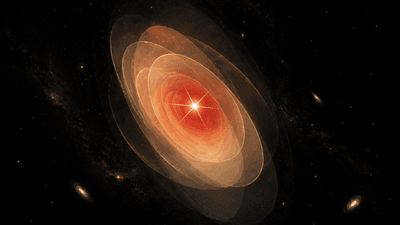
One of the biggest and most exciting mysteries in extragalactic astronomy of the past few years has been the discovery of the Little Red Dots. As it says on the box, these objects are extremely compact, red, and have basically no other features. Now new work shows where they might sit in the broader picture of galaxy evolution.
From the get-go, astronomers have suggested these Little Red Dots (LRDs) are an early phase in the formation of cosmic objects: maybe the seeds of supermassive black holes or extremely compact galaxies. In either case, one would still expect to see evidence of a wider galaxy surrounding these distant sources. Until recently, nobody had been successful.
Professor Xuheng Ding from Wuhan University and Lilan Yang from Hunan Normal University in China had an intriguing approach to look for those structures. They combined over 200 images of LRDs and saw that statistically, across all the wavelengths of JWST, galaxy structures appeared.
The main result is that Little Red Dots are not simply isolated points of light. At least statistically, they are embedded in compact host galaxies.
Xuheng Ding
"In our study, we combined observations of 217 Little Red Dots in four different JWST wavelength bands. By stacking many images together, essentially adding up many very faint signals, we were able to reveal extended light around the central point source that is too faint to see clearly in most individual objects,” Ding told IFLScience.
The team found that the typical stellar mass around LRDs is roughly 1 billion times the mass of the Sun, which is less than 1 percent of the mass of the Milky Way. Unlike the Milky Way, however, which stretches for over 100,000 light-years, all that mass is confined to just 685 light-years.
Consequently, these objects are tiny and dense: 2.5 times more compact than star-forming galaxies of similar mass that can be observed during the same time period, over 10 billion years ago.
“The main result is that Little Red Dots are not simply isolated points of light. At least statistically, they are embedded in compact host galaxies. This gives us a much clearer picture of what these mysterious objects actually are and provides an important new clue to understanding how galaxies and their central black holes were growing together in the early Universe,” Professor Ding told IFLScience.
Joining the dots
Recently, evidence was published suggesting that the center of the LRDs – what we can actually see in a regular observation – is a new type of object called a Black Hole Star, where a black hole is shrouded by gas, which it heats up a bit like a star.
This new work doesn’t confirm or conflict with that hypothesis, focusing on what would surround the central bit of the LRD. The team is upfront about how this is just the beginning, and more follow-up work is needed to confirm their findings.
“First, we would like to repeat this analysis with larger samples of Little Red Dots from independent JWST fields. Our current result is based on 217 objects from COSMOS-Web, so finding the same extended emission in different areas of the sky would be an important test of whether compact host galaxies are a general property of the Little Red Dot population,” Professor Ding told IFLScience.
The team also wants deeper observations so they can see the currently invisible galactic structures around the individual LRDs. Observations in more wavelengths and even spectroscopic analysis (breaking the light into its component colors), would allow for better characterization of what these galaxies' properties really are.
“With substantially deeper JWST observations, the ideal next step would be to directly detect and characterize the host galaxies of individual Little Red Dots,” Ding continued.
The Little Red Dots remain one of the most exciting findings of JWST, and slowly but surely, the mystery is getting solved.
A paper describing these results was published in the journal Nature Astronomy.