Space and Physics
 PUBLISHED



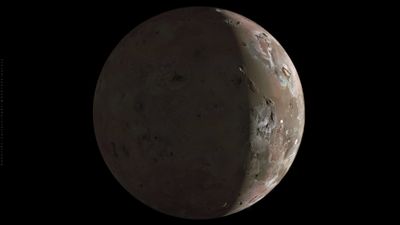


NASA’s Juno conducted its 58th close encounter with Jupiter (perijove) at the weekend and its final close flyby of Io, the innermost of Jupiter's four Galilean moons. Io is known for the volcanic activity that marks its surface, the first active volcanoes discovered beyond Earth. The latest photos have caught some of those volcanoes erupting.
Juno has already performed a close flyby of Io, just over a month ago on December 30. Over the last year, Juno has progressively gotten closer to the volcanic moon, culminating in these last two observations with a specific goal: work out what goes on inside Io. In both cases, the spacecraft was about 1,500 kilometers (930 miles) at its closest point to the moon.

Jupiter’s gravity and the effect of two of the other three Galilean moons (Europa and Ganymede) are believed to be the cause of the volcanism. A tidal tug-of-war is happening among the objects, heating up the interior of the moons. Europa’s under-ice ocean or Ganymede's unique magnetic field are also thought to be connected to the process.
However, many uncertainties remain so the flyby is set to show if a global magma ocean exists under the surface of Io, breaking through in lava lakes and volcanoes.
“Io is the most volcanic celestial body that we know of in our Solar System,” Scott Bolton, Juno principal investigator from the Southwest Research Institute, said during an earlier approach to Io last year.
“By observing it over time on multiple passes, we can watch how the volcanoes vary – how often they erupt, how bright and hot they are, whether they are linked to a group or solo, and if the shape of the lava flow changes.”
While Juno’s original mission was to study Jupiter and its internal processes, as the mission was extended, the team was more daring in the close passages past the moon, ultimately providing the closest look at the moons in decades, as well as important new insights into their internal processes.
The spacecraft has been around Jupiter since July 5, 2016, and it has many months of science left. Its orbit around the planet has been shorted too. It originally had a perijove every 53 days, this was reduced to 43 in 2021, to 38 in 2022, and from now on, it will be every 33 days. The second extended mission ends in September 2025.