Humans
 PUBLISHED


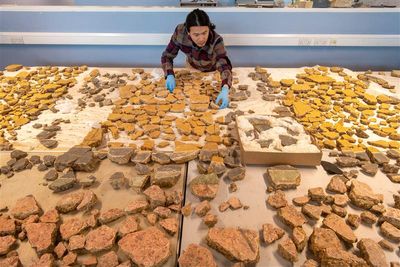


Archaeologists in London have reconstructed ancient Roman frescoes that have not been seen for over 1,800 years. The work involved reassembling thousands of fragments that were once abandoned in a pit after the original building was demolished around 200 CE.
The reconstruction work was performed by Han Li, the Senior Building Material Specialist at the Museum of London Archaeology (MOLA), over several painstaking months.
“This has been a ‘once in a lifetime’ moment, so I felt a mix of excitement and nervousness when I started to lay the plaster out”, Li explained in a statement.
“Many of the fragments were very delicate and pieces from different walls had been jumbled together when the building was demolished. It was like assembling the world’s most difficult jigsaw puzzle.”

As Li gradually put the pieces together, the fragments started to make more sense, offering a glimpse of designs, such as bright yellow panels with black intervals, as well as birds, fruit, and lyres. The latter is a stringed instrument resembling a harp.
The decorated plaster was found dumped in a large pit at a London development site that has previously yielded other incredible mosaics and a rare Roman mausoleum. It is believed that the paintings were designed to show off the wealth and taste of the original building’s owner(s), who must have been well off.
Panel designs were common during the Roman period, but yellow wasn’t, so its inclusion here is noteworthy. In fact, other examples have only been identified at a few other sites in the country, such as Fishbourne Roman Palace in Chichester, Sussex.
It also seems that whoever painted these panels took inspiration from wall decorations in other parts of the Roman world, such as Xanten and Cologne in Germany, and Lyon in France.
The artists also seem to have imitated some of the high-status wall tiles, like the red Egyptian porphyry (a rare red crystal speckled volcanic stone) that frames incredible veins of African giallo antico (a yellow marble). This style has been found in other parts of ancient London, as well as in Colchester in Essex, England, Germany, and Pompeii.
Within the collection of shards, the team also found a tangible link to the artist who painted them – the remains of a signature. This is the first known example in Britain, and is framed by a tabula ansata, a carving of a decorative tablet used to sign artwork at the time. It contains the word “FECIT”, a Latin word meaning “has made this”. Unfortunately, the fragment with the artist’s name is not visible on the broken fragments, so we will likely never know who they were.
Another first for the British context is evidence of graffiti in the form of an etching of a near-complete Greek alphabet. Other examples of this design have been found elsewhere in the Roman world, and it's thought to be a kind of checklist or reference.
The design was clearly created by someone with skill, so it is unlikely it was made by someone during their writing practice.
The plaster fragments are still being examined by Li and his colleagues. The results of their ongoing work will be published and fragments archived for further study.
“I was lucky to have been helped by my colleagues in other specialist teams for helping me arrange this titanic puzzle as well as interpret ornaments and inscriptions – including Ian Betts and the British School at Rome – who gave me their invaluable opinions and resources. The result was seeing wall paintings that even individuals of the late Roman period in London would not have seen,” Li added.