Nature
 PUBLISHED
 1
1


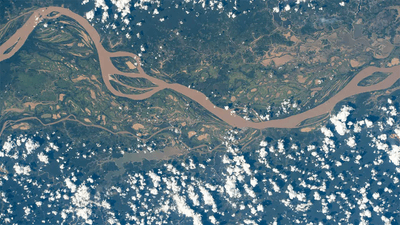


The Amazon River is the world's largest drainage system by both water volume and basin size. It may also be the longest river in the world, but that depends on whether we can agree on its source, and that turns out to be a surprisingly controversial topic.
Stretching around 6,400 kilometers (4,000 miles), it originates in Peru's Andes Mountains, flows across South America, and empties into the Atlantic Ocean.
That hasn't always been the case. In 2006, geologist Russell Mapes, then a graduate student, was attempting to investigate the flow of river sediment from the Andes Mountains to the Atlantic Ocean, when he noticed something that shouldn't be there: tiny, ancient pieces of zircon.
These gemstone deposits could not have come from the younger Andes, and must have come from the eastern direction, suggesting that at some point in the planet's past, the Amazon River ran in the opposite direction. As well as this, fossils of marine creatures have been found that could only have arrived there if the Amazon did the old switcharoo.
The Amazon once flowed backwards
There are two possible ways in which this could have taken place. The initial team proposed that before the Andes Mountains existed, the region's slope caused the river to flow from east to west towards the Purus Arch, while water on the arch's western side drained into the Pacific Ocean.
As elevated areas in the northeast gradually eroded, the team argued, the flow direction began to reverse. Meanwhile, the rising Andes created a large basin between the mountains and the Purus Arch. Over time, this basin filled with water until it eventually overflowed, establishing the eastward-flowing Amazon system seen today.
Alternatively, in 2014 another team proposed that as the Andes rose they intercepted more clouds, forming the Pebas wetlands. As sediment built up, the flow reversed. Though the cause of this shift is still debated, it is thought to have taken place around 10 million years ago.
The source of the Amazon river
You can see why topics like this can become controversial, but what about a nice simple question like "what is the source of the Amazon?". Unfortunately, that isn't as clear cut as you'd like, either.
The easy copout answer is that it doesn't have one specific source, but is fed by over a thousand tributaries, some of them, like the Madeira River, far larger than others. But we don't want a copout answer, damnit, we want an answer we can feasibly give in a quiz. So where is the Amazon's primary source? Now we're getting into the heart of the problem, defining what a river's source is.
In the 1700s, people were happy to call the Marañón River in northern Peru the source of the Amazon, on the grounds that this branch contributed the largest volume of water, making it a reasonable choice. But that definition of a source evolved over the years.
"A river’s source can be defined as either (a) the farthest upstream point along the main river, found by following the channels with the highest average discharge (the ‘mainstem’) or (b) the absolute farthest upstream point in the entire river basin, which may involve following a tributary upstream," a 2014 paper, which argued for a new definition altogether, explains.
"These two source points are best termed the ‘principal source’ and ‘most distant source’, respectively, and may or may not coincide."
As the definition changed, and the Amazon was explored further, so did the source. The Ucayali River took the title, as the longest of the Amazon's tributaries. So that's that all settled? No.
With more exploration and satellite imagery of the Amazon and its tributaries, in 2014 one team argued that the Mantaro River is the source of the Amazon, and that it was long enough to make the Amazon slightly longer than the Nile, making it the longest river in the world.
"We have established that the most distant source of the Amazon River system is located in the Río Mantaro drainage rather than the Apurímac drainage," the team wrote in their paper.
"Compared with the headwaters of the Apurímac at Nevado Mismi, the new most distant source position at the Cordillera Rumi Cruz is 754 km northwest (as a condor flies) and 4.36°–4.75° further north (from 15.52°S to the more tropical 10.09–10.75°S). This is a substantial repositioning of a major geographical feature from the southern Peruvian puna to the central Peruvian puna."
So now everything is settled, right? No, and quite frankly you should have seen that coming. The problem with the Montaro River being the source, is that for around five months of the year the Montaro river runs dry, the result of the Tablachaca dam, which was built in 1974. And many geographers aren't too happy with the source of the Amazon River, famous for its sheer volume of flow, having its source be dry for nearly half the year.
That team instead proposed that a new definition was needed, to include a most distant source, as well as a most distant source of continuous flow. If you would like to go back to the copout answer, the Amazon is fed by many tributaries, with the Marañón, the Apurímac, and the Mantaro, contributing the most significant flow.