Space and Physics
 PUBLISHED




Comet 3I/ATLAS continues to be found exceptional. The third known interstellar object is a weird comet, with many properties that place it at the extreme end of the range compared to the bulk of the Solar System’s comets. New analysis of observations taken a few months back has revealed another oddity, one that has implications for 3I/ATLAS's place of birth. Even its cradle is extreme.
The observations by ALMA, the Atacama Large Millimeter Array, were taken just six days after 3I/ATLAS was at perihelion, its closest approach to the Sun. They reveal something unexpected about the composition of the interstellar comet. An incredible amount of semi-heavy water.
Hydrogen is the most common element in the universe and, in its simplest form, is made of one electron and a proton in its nucleus. It is possible for hydrogen to have one or two neutrons in its nucleus as well. The form with one is called deuterium, and when a water molecule is made of one oxygen, one regular hydrogen, and one deuterium, it is called semi-heavy.
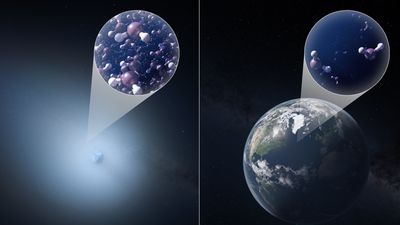
Semi-heavy water is rare in nature but not so rare that it is surprising to see it in comets. Actually measuring the ratio of deuterated water to regular water in a comet is what revealed that they are not the main source of Earth’s water; they have a little bit too much.
Interstellar comet 3I/ATLAS is even more extreme. The ratio of semi-heavy water to regular water is 30 times larger than in comets that formed within our own Solar System and over 40 times the ratio found in Earth’s oceans. This has major implications for how the comet came to be.
“The chemical processes that lead to the enhancement of deuterated water are really sensitive to temperature and usually require environments colder than about 30 Kelvin, or about minus 406 degrees Fahrenheit,” lead author Luis E. Salazar Manzano, a graduate researcher at the University of Michigan, said in a statement.
At -243°C, the birthplace of 3I/ATLAS must be far colder and with certain specific radiation conditions to produce such a ratio. The comet’s value is different from the natural ratio of deuterium to hydrogen from the Big Bang. Some mechanism must have enhanced it before being thrown out into interstellar space.
“We now know that the cloud of gas that formed the star and other planets in the system where 3I/ATLAS came from was likely very cold and had very different conditions than the environment that created our Solar System and local comets,” Salazar Manzano continued.
It is incredible what ALMA has been able to achieve; as a radio telescope, it was able to observe the comet right as it was peeking out from behind the Sun. Earth and 3I/ATLAS were on the opposite side of our star when the comet got its closest on October 29, 2025.
This is the first time astronomers have measured the deuterated water ratio in an interstellar object. We haven’t even done it for 1I/’Oumuamua, discovered in 2017, or Comet 2I/Borisov in 2019. Still, each interstellar visitor is giving us insight into what other planetary systems are like.
“Each interstellar comet brings a little bit of its history, its fossils, from elsewhere. We don’t know exactly where, but with instruments like ALMA, we can begin to understand the conditions of that place and compare them to our own,” co-author Assistant Professor Teresa Paneque-Carreño explained.
"Our new observations show that the conditions that led to the formation of our Solar System are much different from how planetary systems evolved in different parts of our Galaxy," said Salazar Manzano.
A paper describing these observations is published in the journal Nature Astronomy.