Humans
 PUBLISHED
 1
1


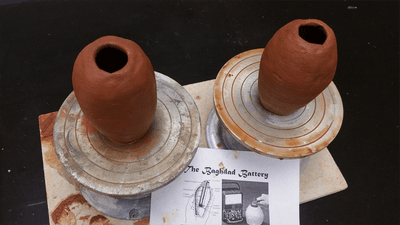


A new study and experimental recreation of the infamous "Baghdad battery" has suggested that the controversial clay jar may have been a battery after all. However, given what we know about the time, and lack of other supporting evidence, it is best to remain skeptical.
In 1938, German archaeologist Wilhelm König found a clay jar in Khujut Rabu just outside Baghdad. The jar was covered with a stopper made of asphalt and is believed to be around 2,000 years old. But the bit that interested a number of archaeologists and scientists was the contents: an iron rod inside a copper cylinder. This got some people wondering – could it possibly be an ancient battery?
König was the first to suggest that the jar was used as an ancient battery, 18 centuries before the first true battery was invented.
While the idea was certainly a leap in the imagination, the jar would work as a battery. After World War II, engineer Willard Gray took a replica of the Baghdad Battery, filled it with grape juice, and was able to produce 1.5-2 volts of electricity. Nothing to write home about, but definitely a charge. Subsequent experiments have confirmed the setup could produce power if the owner had the necessary knowledge and grape juice.
Even Mythbusters tested the theory. The team took 10 replica jars and filled them with lemon as the electrolyte. The jars produced just 0.5 volts on their own, but when hooked up together they managed to produce 4.5 volts, which they deemed made the myth plausible.
In the new study, independent researcher Alexander Bazes attempted to recreate the "battery" and measure its electrical output. Bazes argues that previous research, which found the jar produces only a little power, overlooked key aspects of its design: it is actually two batteries in one.
"The present study’s recreation dispels this doubt by accounting for two previously neglected aspects of the artifact’s design, namely the use of solder and the function of the ceramic jar, which together form a previously unrecognized second source of voltage for the device: an aqueous tinair battery," Bazes writes.
"This 'outer cell,' which is integrally connected in electrical series with the device’s already well-understood 'inner cell' (comprising copper and iron), enables the Baghdad Battery to generate over 1.4 volts: an electric potential capable of driving a number of useful (and highly noticeable) electrochemical reactions, including electroplating, etching, and the electrolysis of water into hydrogen and oxygen gas."
According to Bazes, the recreation produced voltage that was capable of producing visible electrochemical reactions.
"This result provides the strongest evidence to date for König’s original hypothesis that people in the Near East had a working knowledge of electrochemistry nearly two millennia before Alessandro Volta’s experiments with the voltaic pile," Bazes adds.
If it was a battery (spoiler alert; it probably wasn't, even if it could be used as such), then what was its purpose? People have suggested that it could have been used for electroplating, or as a therapeutic tool. Dr Paul Craddock, a metallurgy expert from the British Museum, suggested a much more outlandish theory that people could use it for a trick in a temple.
"The statue of a god could be wired up and then the priest would ask you questions," Craddock told the BBC in 2003.
"If you gave the wrong answer, you'd touch the statue and would get a minor shock along with perhaps a small mysterious blue flash of light. Get the answer right, and the trickster or priest could disconnect the batteries and no shock would arrive – the person would then be convinced of the power of the statue, priest and the religion."
But while the evidence that the jars could produce charge is interesting, it doesn't mean that this is how they were used 2,000 years ago (or maybe less time than that, as there are questions about the dating of the jar, with some putting it at around 225 CE).
"As is always the case in experimental archaeology, successful experiments alone can show only a supposed ancient technique to be possible, but never its application," chemist Gerhard Eggert explained in an article for Skeptical Inquirer. "For instance, Thor Heyerdahl only showed with his Ra voyage that in principle it is possible to cross the Atlantic in an Egyptian boat. To accept the claim that the Egyptians really did so, one would need archaeological evidence from America (such evidence exists for the Vikings)."
It could be that the Parthians (or the Sassanians, if later dating is correct) knew about the effect of the jars (e.g. a pleasant zap or tingling) without knowing the underlying reasons why it works. But there is little in the way of evidence to show that ancient people had knowledge of electrotherapy or electroplating, or that ancient objects had been electrogilded. No similar items have been found in the area, suggesting that if they did have knowledge of batteries, proponents of the battery theory would have to explain why this knowledge didn't spread.
"By discussing the magical meaning of metals in antiquity, Paszthory (1989) has argued (like most of the excavators half a century earlier) that such objects might have been containers for blessings or incantations written on organic material," Eggert adds. "This answers convincingly the question of the claim's proponents: What else could it have been?"
An alternative, and far more likely, explanation is that the jar was used to house scrolls, as it is similar to storage vessels found in nearby Seleucia. How much more likely is it? As Professor Elizabeth Stone, an expert on Iraqi archaeology, said in 2012, to her recollection no archaeologist she knew believed the jars were batteries. Unfortunately, the jar itself was looted during the 2003 US invasion of Iraq, making further study of it impossible.
The study is published in Sino-Platonic Papers.