Space and Physics
 PUBLISHED
 2
2



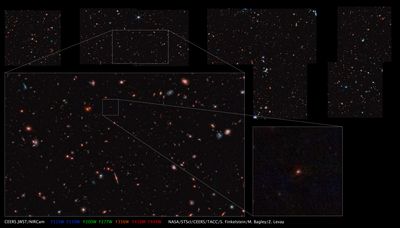


Last year, scientists in the Cosmic Evolution Early Release Science (CEERS) program on JWST found one of the most distant galaxies ever observed. Nicknamed Maisie’s Galaxy after the daughter of one of the discoverers, its light comes to us from just 390 million years after the Big Bang – the time when galaxies were being born across the universe.
Now, the Space Telescope Science Institute has put together an incredible 3D visualization that allows you to fly through space toward Maisie’s Galaxy at a speed that not even sci-fi writers have ever suggested. Each second of visualization takes you back into the past by about 200 million years, until you get to the galaxy about 68 seconds in.
Converting it into a distance is not exactly straightforward. Due to the accelerated expansion of the universe, things that are further away from us have been receding away more quickly. That’s because the universe expands in the same manner and in every direction everywhere. So if we were to magically fly to Maisie’s Galaxy today we would cover a distance of over 33 billion light-years.
The peculiar physics of our universe and just what JWST is seeing – and when – might baffle you or you may want to explore it more (check out our in-depth explainer last year). Regardless, you can take less than a minute and a half to relax and enjoy this spectacular flight into the distant early universe.