Space and Physics
 PUBLISHED




You’ve probably seen by now all of the spectacular images of Monday’s (April 8) eclipse taken from the ground. But what about those taken from space and sky? We’ve got you covered.
Total solar eclipses happen when the Moon passes between the Sun and Earth, temporarily blocking the Sun’s light and plunging those in the Moon’s shadow – or the path of totality – into darkness. On Monday, this 185-kilometer (115-mile) wide path spanned North America – from Mexico to the very eastern tip of Canada, meaning millions of people across the continent caught sight of the Sun being briefly obscured.
The view from space, however, was quite different, and, thankfully, some satellites were able to catch it.
One such satellite is the Geostationary Operational Environmental Satellite (GOES-16), which captured the Moon’s shadow moving across North America between 4 pm and 11 pm CEST (2 pm and 9 pm UTC).
Situated some 36,000 kilometers (22,000 miles) away, the GOES satellites are a collaboration between the National Oceanic and Atmospheric Administration (NOAA) and NASA.
ⓘ IFLScience is not responsible for content shared from external sites.
SpaceX’s Starlink satellites also recorded some footage of the shadow as it raced eastward over North America.
ⓘ IFLScience is not responsible for content shared from external sites.
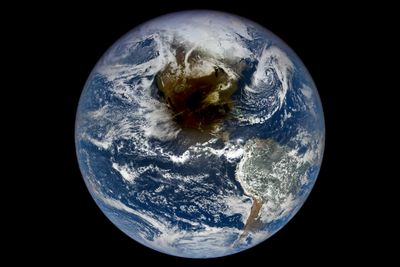
As did NASA’s EPIC (Earth Polychromatic Imaging Camera) imager on the DSCOVR (Deep Space Climate Observatory) satellite, which snapped the view of Earth seen below between 4 pm and 8:30 pm UTC.

As the Moon’s shadow swept from the Pacific coast of Mexico to the Atlantic coast of Newfoundland, Canada via Texas and The Great Lakes, the NOAA-20 satellite, which orbits Earth from pole to pole, captured images of the planet from east to west. The mosaic below is comprised of three images taken before, during, and after the eclipse.

It wasn’t just space satellites that peeped the spectacle from an alternative angle. NASA astronaut Jessica Meir shared footage of the path of totality over north Texas, taken in a T38 jet at 11,900 meters (39,000 feet).
ⓘ IFLScience is not responsible for content shared from external sites.
If you were wondering what it’s like to view an eclipse from the sky, Meir said of the experience: “We saw the darkness approaching us from behind. Soon it caught up with us and we had several minutes in totality as we chased along its path. Then we were back in the light once again. Not a bad day in the office..”