Space and Physics
 PUBLISHED


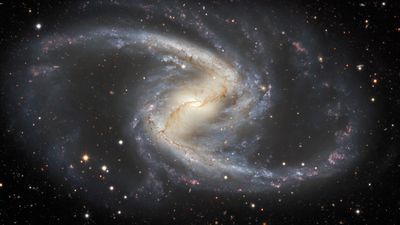


Spiral galaxy NGC 1365 is located about 56 million light-years from us. It is a pretty special galaxy, with two beautiful spiral arms and not one but two bar-like structures in its core. Now, it is even more special as it was the first extragalactic target of an important astronomical technique known as space archaeology.
This approach doesn’t need to dig anywhere, however. Well, maybe it needs to dig into data and simulations. Armed with both, astronomers can work out the history of a galaxy. In this case, to trace the last 12 billion years of evolution of this object. It's an incredible demonstration of how "extragalactic archaeology" can reveal the "fossil records" of distant galaxies.
In the Milky Way, this is done by studying the motion of stars; this cannot be done for other galaxies, as they are too far away, and you can't measure the motions of stars to the required level of detail. So the team focused on the distribution of oxygen. Simulations of galaxies have gotten pretty sophisticated; it was observations that were not detailed enough to provide the level necessary to employ this technique. Thanks to data from the TYPHOON survey on the Irénée du Pont telescope at the Las Campanas Observatory, the team was able to track the distribution of oxygen in exquisite detail.
This is the first time that we've been able to do this type of archaeology technique to a galaxy outside the Milky Way.
Professor Lisa Kewley
“We've actually found in this galaxy that there's quite a lot of oxygen in the central regions,” lead author Harvard Professor Lisa Kewley, director of the Center for Astrophysics, told IFLScience. “Then it starts going down as you move out in radius in the galaxy. Then, at the edge of the galaxy, the amount of oxygen is really constant all the way around on both spiral arms. And so we asked the question: OK, well, how did this happen in this galaxy?”
They were able to match these observations with 20,000 different models of galaxy evolution. Only one matched the observations they were seeing. Using that model, they had a history of NGC 1365. It suggested that the central region formed earlier and was enriched in oxygen. The gas in the spiral arms formed later, from mergers with dwarf galaxies,
“We can actually see those dwarf galaxies coming in the simulations and figure out when they merged and what that did to the subsequent evolution of the galaxy,” Professor Kewley told IFLScience.
NGC 1365 started as a small galaxy and then grew to its considerable size thanks to merging events that took place over billions of years. Finding that out was only possible thanks to space archaeology.
“This is the first time that we've been able to do this type of archaeology technique to a galaxy outside the Milky Way,” Professor Kewley told IFLScience. “It's an incredibly powerful technique that we're super excited to apply to other galaxies in the future.”
The galaxies have to be close to be targets because it’s crucial to have a lot of details about their gas distribution. Much closer objects like Andromeda are good targets for this technique, but there are plenty more that are also worth exploring.
The study is published in the journal Nature Astronomy.