Culture and Society
 PUBLISHED
 20
20


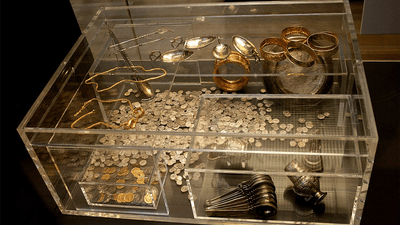


In 1992, a man looking for a lost hammer in Hoxne in Suffolk, UK, ended up finding an ancient chest containing treasure worth around £1.75 million (around £4.7 million or $6.3 million today).
In November 1992, Hoxne farmer Peter Whatling lost track of his hammer and enlisted the help of a friend of his to find it. Eric Lawes was a retired gardener and current amateur metal detectorist, and was happy to head out into the fields to begin searching for it. On November 16, Lawes found a number of items, including ancient coins and spoons. Rather than fleeing for the nearest illicit artifact dealer and/or Mexico, he reported his discovery to the local police and archaeological service for them to investigate further.
That, it turns out, was a pretty good move, archaeologically speaking. Since he stopped once he had found a few items, professional archaeologists were able to move in and document where each artifact was found. And there were a lot of artifacts to get through.
"The Hoxne Treasure, discovered in November 1992, is one of the most significant hoards of late Roman gold and silver from Britain," a paper on the topic explains. "In terms of its sheer monetary value it has been placed fifth in the international ‘top ten’ of precious-metal hoards from the second to the seventh centuries AD."
Now known as the Hoxne Hoard, archaeologists found a substantial haul. The collection includes 15,233 coins, silver vessels, gold jewelry, and many more spoons, as well as (somewhat less valuable) toilet utensils.
"In addition, there were remains of wood and other organic materials, which made it possible to establish that the treasure was packed in a wooden chest with internal boxes or subdivisions, as well as straw and textile wrappings for protection," the paper adds.
The oak box and its contents are believed to have been placed there deliberately, sometime in the 5th century CE. We know that the coins were placed after 407/408 CE, when a few of the coins were dated to, though most were from a few decades before that, providing archaeologists with information on how long Roman coins remained in circulation. While archaeologists can learn a lot from the hoard, there are still a lot of unknowns. It is thought that the treasure was placed there deliberately, but it is not known why.
"The names of those who owned these items and buried them will always remain a mystery, and we cannot say definitively why these items were hidden in the first place," another paper explains. "It may be as a result of the dangerous and unstable conditions that plagued Roman Britain during the end of the fourth and beginning of the fifth century [CE], or of the changed economic climate that witnessed the collapse of a Late Antique, Romano-British gift exchange network among the elite; the treasure may be the spoils from a robbery."
In 1993, Lawes got a reward for his good work when the hoard was declared a treasure trove, meaning valuable items that had been intentionally placed and then not recovered by the owner. At that point, the treasure is given to the Crown, who sold it off to museums at the market value. This was then given to the finder, Lawes, who split it with the landowner. Between them, they were given £1.75 million, which isn't bad when they were only hoping to find a lost hammer.