Space and Physics
 PUBLISHED


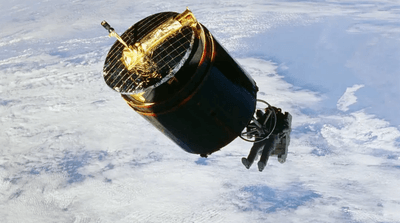


Plenty of images from space exploration tread a fine line between spine-chilling and awe-inspiring, but this footage of NASA astronaut Dale Gardner flying untethered through space might top them all.
There are a lot of hair-raising things you can find in space, from mysterious massive voids 250 to 330 million light-years across, to tiny droplets of water in your space suit that could very easily drown you. But the moniker of "most terrifying space photo" is generally given to a photo of astronaut Bruce McCandless II, taken from the space shuttle Challenger on February 7, 1984.
On that day, and again on February 9, he and fellow astronaut Bob Stewart strapped themselves into Manned Maneuvering Units (MMUs) and left the comfort of their ship to make an untethered space walk as they and Challenger hurtled along at nearly 28,900 kilometers per hour (18,000 miles per hour).
Bruce was the first to make the leap, becoming the first human in history to make an untethered spacewalk. The image (below) is quite something.
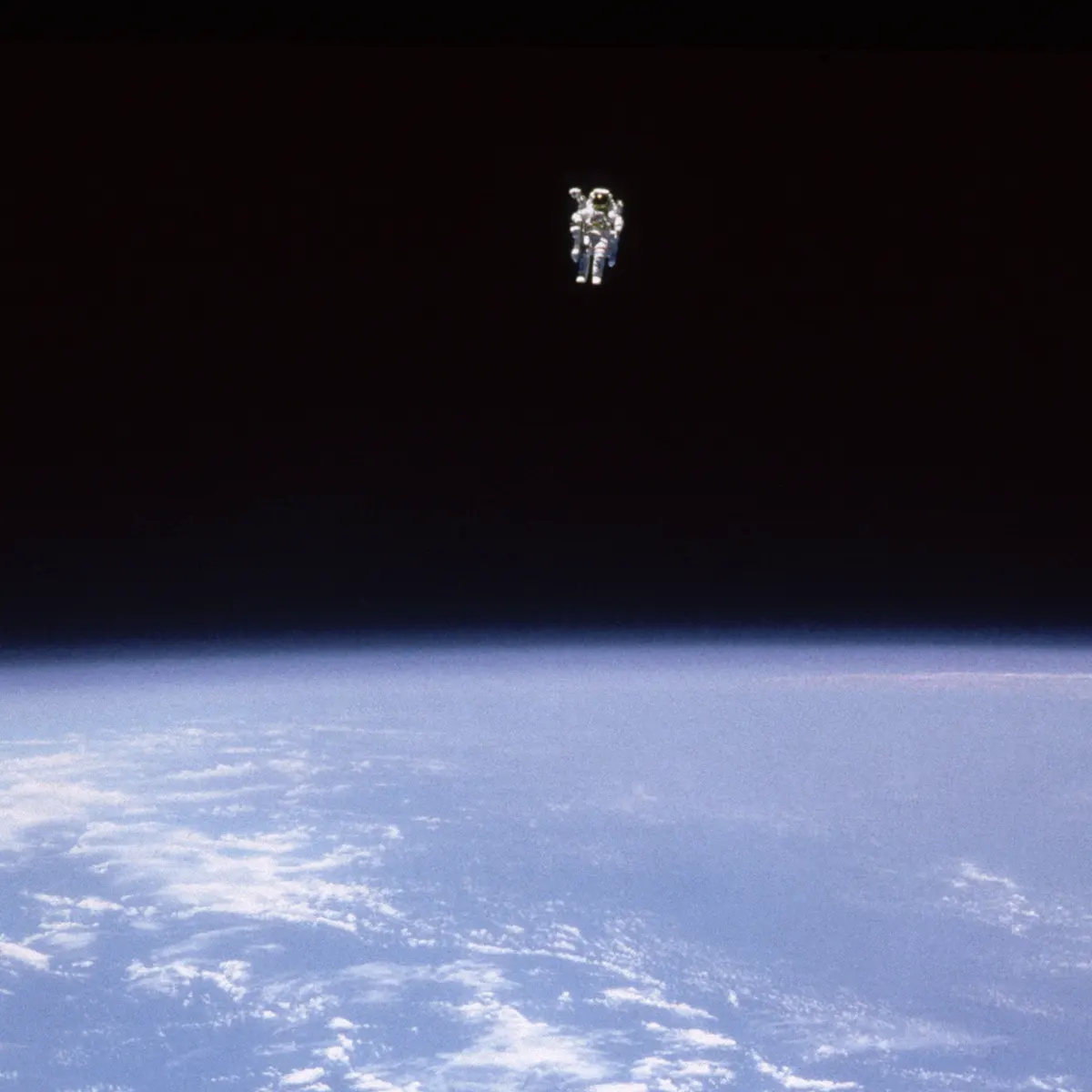
While truly terrifying, there's an overlooked NASA spacewalk which looks equally nightmarish to untrained Earth-dwellers. In 1984, astronaut Dale Gardner and Joseph Allen flew untethered to recover two communication satellites that had been placed into incorrect orbits due to rocket failure.
With boosters unable to place the satellites into their correct orbits, NASA devised a plan for astronauts to don spacesuits and Manned Maneuvering Units (MMUs) to retrieve the Westar 6 and Palapa B2 satellites for return to Earth, while Anna Fisher operated a Remote Manipulator System.
Both Gardner and Allen took turns collecting satellites untethered, with Gardner flying the MMU to capture Westar.
"After Hauck and Walker piloted Discovery to within 35 feet of Palapa, Allen and Gardner exited the airlock to begin the spacewalk portion of the satellite capture. Allen donned the MMU mounted on the side wall of the cargo bay, attached the stinger to its arms, and flew out to Palapa. Once there, he inserted the stinger into the satellite’s Apogee Kick Motor bell and using the MMU’s attitude control system stopped Palapa’s spin," NASA explains of the first of the two satellite collections.
"Fisher then steered the RMS to capture a grapple fixture mounted on the stinger between Allen and the satellite. She then maneuvered them over the payload bay where Gardner waited to remove its omnidirectional antenna and install the bridge structure. However, Gardner could not attach the ABS to the satellite due to an unexpected clearance issue on the satellite. Using a backup plan, Allen undocked from the stinger, leaving it attached to the satellite as well as the RMS, and stowed the MMU in the payload bay. With Allen now holding the satellite by its antenna, Gardner attached an adaptor to the bottom end of the satellite to secure it in its cradle in the payload bay."
The mission was a success, with the satellite captured within 6 hours. The second satellite collection, by Gardner, went without a hitch and was completed in 5 hours and 42 minutes. Both satellites were returned to Earth, along with some of the most blood-curdling space footage we've seen.
An earlier version of this article was published in March 2025.