Culture and Society
 PUBLISHED


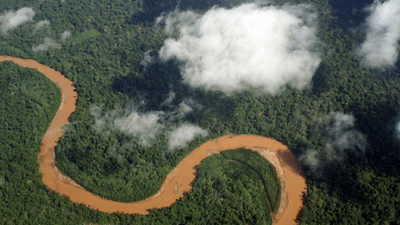


In 1981, four men ventured into the Bolivian Amazon in search of gold and adventure. Three weeks later, one of them would be pulled alive from the rainforest after being presumed dead.
Two others would vanish without a trace, and more than four decades later, the fate of Karl Ruprechter and Marcus Stamm would remain one of the Amazon's enduring mysteries.
An Amazon adventure, 1981
Yossi Ghinsberg traveled to South America in 1981 to explore the most remote regions of the Amazon rainforest, a dream inspired by reading Henri Charrière's Papillon. During his travels, he met a man named Marcus Stamm and the two became firm friends. When they reached La Paz, Bolivia, they met Kevin Gale, an American photographer. What happened next would change their lives forever.
A chance meeting with Karl Ruprechter presented the trio with an opportunity: a guided journey into the depths of the Amazon where he claimed they could find an isolated Indigenous community. Along the way, they would pan for gold as a means of payment.
The first stretch of their journey, down the Tuichi River to the village of Asariamas, was largely uneventful. After restocking their supplies, they continued deeper into the rainforest. Before long, however, dwindling food supplies and harsh conditions took their toll. Stamm's health deteriorated and the group decided to return to Asariamas.
There, they made a new plan. Rather than continuing on foot, they would build a raft and travel down the Tuichi River to Curiplaya, where Ruprechter claimed there was gold to be found along the riverbed. From there, they would continue downstream to Rurrenabaque.
Splitting up
The plan soon unraveled. Ruprechter later revealed that they could not safely navigate the dangerous rapids of San Pedro Canyon and refused to continue. At this point, the group split up. Stamm accompanied Ruprechter back along the Ipurama River towards a village for medical help, while Ghinsberg and Gale continued on by raft. It proved to be a fateful decision.
Not long after, Ghinsberg and Gale encountered severe rapids leading towards a waterfall. Gale managed to make it to shore, but Ghinsberg was swept away by the violent current and carried deep into the rainforest. And so began a 19-day battle for survival.
Food was scarce, and swarms of insects left him covered in bites. He developed trench foot in the waterlogged conditions and resorted to inducing the stings of fire ants to try and dull the pain so that he could continue. He also became host to bot fly larvae, a parasitic insect whose young develop beneath the skin of living animals before emerging as winged adults.
As the days passed, hopes that Ghinsberg would be found alive were dwindling. Gale, however, refused to give up hope. With the help of local people and Indigenous communities, he searched first by air and later by boat. Eventually, he spotted the emaciated Ghinsberg on a remote stretch of riverbank and brought his 19-day ordeal to an end.
What happened to Marcus Stamm and Karl Ruprechter?
Against all odds, Ghinsberg made it home. The same could not be said for Stamm and Ruprechter. After leaving the expedition, the pair disappeared into the rainforest and were never seen again. Despite extensive searches, no trace of either man was ever found.
Their story is one of many reminders that the Amazon remains one of the most unforgiving environments on Earth. While home to Indigenous communities that have lived off and shaped the land for millennia, it can be very unforgiving to those who aren't familiar with the landscape.
Juliane Koepcke survived the seemingly impossible at just 17 years old when she became the sole survivor of the 1971 LANSA Flight 508 disaster. She endured 11 days alone in the Peruvian Amazon rainforest before finding help. A stark contrast to the fate of 57-year-old British explorer Percy Fawcett who entered the Amazon rainforest in search of "The Lost City Of Z" and vanished without a trace.
More than 40 years later, Ghinsberg's story remains an extraordinary tale of survival (one that you can read about in Ghinsberg's book, Jungle, and see in the dramatized film of the same name). However, the enduring mystery of what became of Marcus Stamm and Karl Ruprechter is a reminder that, even today, there are still places on Earth where a person can become truly lost.