Nature
 PUBLISHED



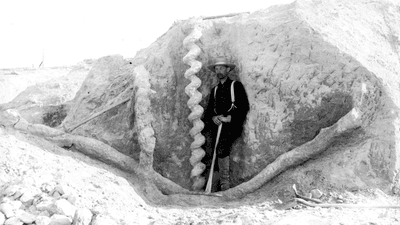


In 1891, geologist and palaeontologist Erwin Hinckley Barbour was presented with a mystery. Digging in the Agate Fossil Beds in Nebraska, his workers discovered some bizarre rocks shaped like fusilli pasta pieces the width of a human arm. It was clear they were some kind of ancient fossil, but of what?
By his own accounts, Barbour was mesmerized by the mysterious fossils. “Their forms are magnificent,” he wrote. “Their symmetry perfect; their organization beyond my comprehension.”
Discovering Daimonelix
To try and make sense of the indescribable, Barbour amassed a large collection of Agate Fossil Bed fossils at the University of Nebraska. It contained many mammalian remains dating to around 20 million years ago, during the early Miocene Epoch, but among them were several spectacular examples of these spiralling fossils.
They were finally given a name when Barbour officially described them in 1892. He called them Daimonelix (or Daemonelix), which is Greek for “devil’s screw”. He bounced around several ideas as to their true identity, including the possibility they were some kind of giant freshwater sponge (and sponges, as we know, come in all kinds of crazy shapes).
But not so, decided Barbour. Instead, he thought the Devil’s screw appeared more like the remains of a plant’s sprawling root system – a hypothesis he felt was supported by the discovery of plant material inside the corkscrew fossils.
Roots vs. burrows
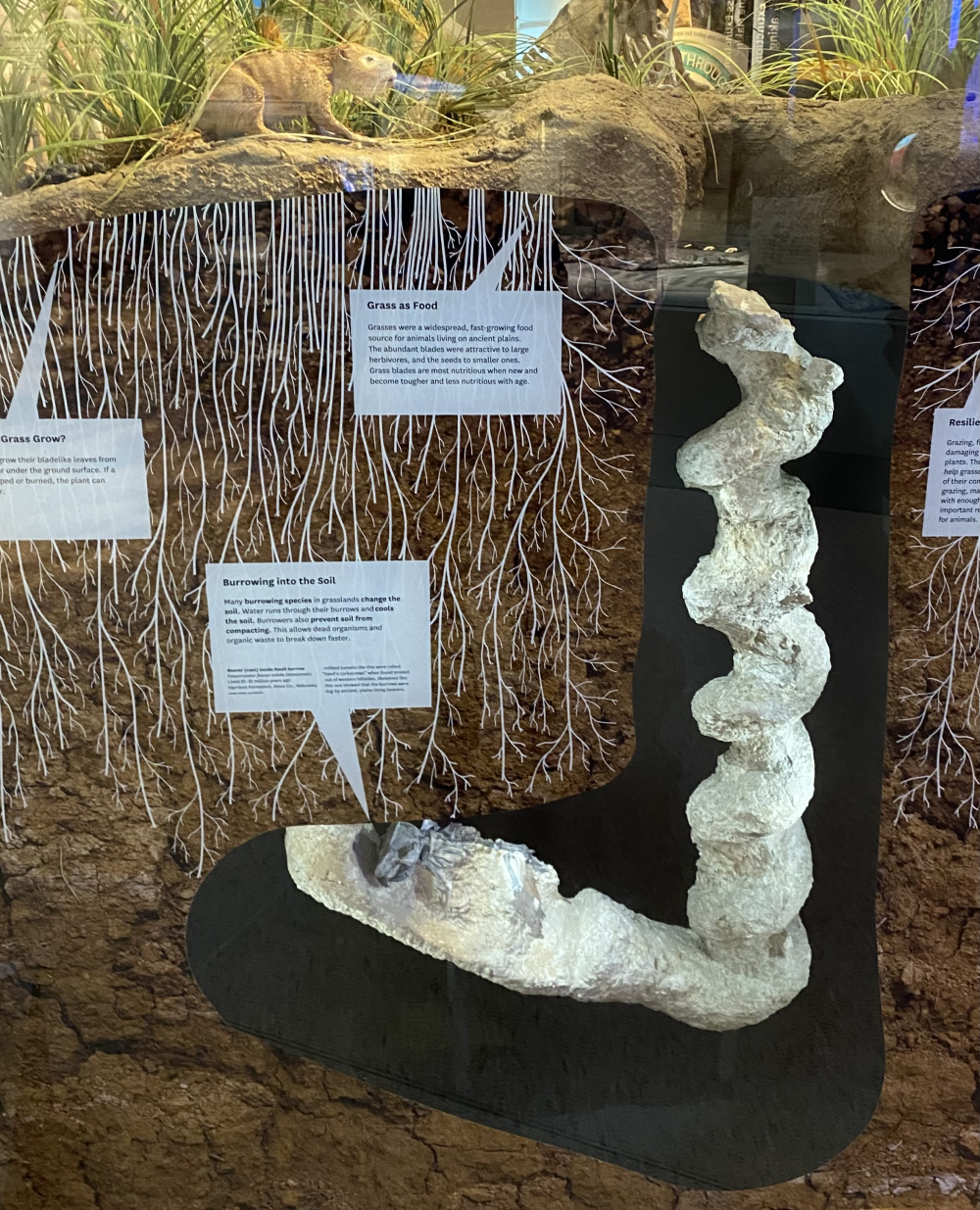
The root theory was challenged when fellow palaeontologist Edward Drinker Cope came onto the scene and offered his own interpretation. The Devil’s screw of Agate was not a plant, he said, but the fossilized burrow of an ancient mammal, perhaps some kind of giant rodent. This would also explain the plant material, which would once have been the mammal's bedding.
Others agreed with Cope, but Barbour couldn’t make sense of it because he believed that the fine sediment of the formation meant it must have once been an ancient lake. That theory would eventually perish, too, as geologists later confirmed that the fine-grained sandy sediments at Agate were, in fact, blown in by winds.
The region wasn’t an ancient lake but experienced seasonal wet and dry conditions. The fine sediment explained why these giant spirals were so well preserved, but the mystery raged on as to what they actually represented.
Palaeocastor: a very clever beaver
In time the burrow theory took hold and come 1977, 85 years after Barbour first described the Devil’s screw of Agate, a study firmly established Daimonelix as the burrows of the extinct beaver Palaeocastor and shed new light on how these animals lived.
This extinct genus of beavers had long, fast-growing front teeth perfect for carving into the earth. They lived in dense underground cities much like modern-day prairie dogs, which is why these spiral structures were found in such high supply in Nebraska.
Theories as to the function of the burrows' spiral shape remain speculative, but it may have been an efficient way to excavate sediment with their teeth. Alternatively, it could have deterred predators or controlled how much moisture got into the burrow, but we still don't know for certain.
Barbour was wrong, then, but his ideas are remembered by the Agate Fossil Bed’s “Daemonelix Trail”, along which you can find Palaeocastor burrows still embedded in the rocky hillside where they were first discovered. A fitting tribute to the joy of getting it wrong in science, and just one of many times we’ve totally misinterpreted ancient remains.