Health and Medicine
 PUBLISHED





The results of the first clinical trial of “enteral ventilation” have been published, and are considered a success, a step along the road to a treatment that could save many lives and prevent even more injuries. Such events happen every day as medicine progresses, but this one stands out because “enteral ventilation” is more popularly known as “butt-breathing” or a few other names you can probably fill in for yourself.
Several Australian turtle species have found a way to delay the dangers of coming to the surface to breathe by extracting oxygen dissolved in water using their cloaca. In other words, they have gill-like features in their bums that supplement their oxygen intake. Dragonfly nymphs do something similar, and even expel the water afterwards as a form of jet propulsion. This, however, is Australia, and you can probably find seventeen weirder animal behaviors within a stone’s throw of a butt-breathing turtle (arguably including their headwear).
Medical applications were probably not the first thing on the mind of those who discovered the trait. However, sick of watching patients struggle for breath with various lung conditions, and inspired by loaches (fish that process air through their stomachs), Dr Takanori Takebe of the Institute of Science, Tokyo, proposed to take an algal leaf out of the turtles’ book. Inevitably, the work was awarded the 2024 Ig Nobel physiology prize for demonstrating the viability of mammals being able to breathe through their butts on some no doubt surprised pigs.
Undeterred by the challenges of getting taken seriously, Takebe has ploughed ahead, and the first results are promising.
"This is the first human data, and the results are limited solely to demonstrating the safety of the procedure and not its effectiveness,” Takebe stressed in a statement. “But now that we have established tolerance, the next step will be to evaluate how effective the process is for delivering oxygen to the bloodstream."
Reptiles’ metabolisms are so much slower than those of mammals that they need far less oxygen, so it is perhaps unsurprising that they can get useful amounts this way. Even then, no known turtle species can rely entirely on this approach for their oxygen needs, the highest being about 80 percent.
Consequently, Takebe and colleagues knew they couldn’t just blow some air up a patient’s ass to keep their blood oxygenated. Their approach is to create a liquid rich in dissolved oxygen, much like deep-sea divers used in the science-fiction film The Abyss, but provide it anally for absorption through the colon. After all, if nutrients can make their way from the intestine straight to the blood, why not oxygen? The liquid, perfluorodecalin, can hold 40-50 times as much oxygen by volume as can be dissolved in water, and about twice as much as human blood holds, but releases it easily.
Surprisingly, the idea actually requires less advanced technology than mechanical ventilators when lungs are failing, and so might be available in remote regions or where finances are more limited. Moreover, ventilators can cause lung injuries, with long-term consequences for the short-term solution.
For this study, 27 healthy Japanese men were administered perfluorodecalin liquid rectally and asked to hold it for 60 minutes. Quantities were increased through the trial, in some cases reaching a liter and a half of the liquid. Twenty of the 27 reached the 60-minute goal, and while those on the larger amounts reported some discomfort and abdominal bloating, there were no serious side effects, nor detectable absorption of the liquid. Discomfort appeared to have been associated with not having defecated during the previous 24 hours.
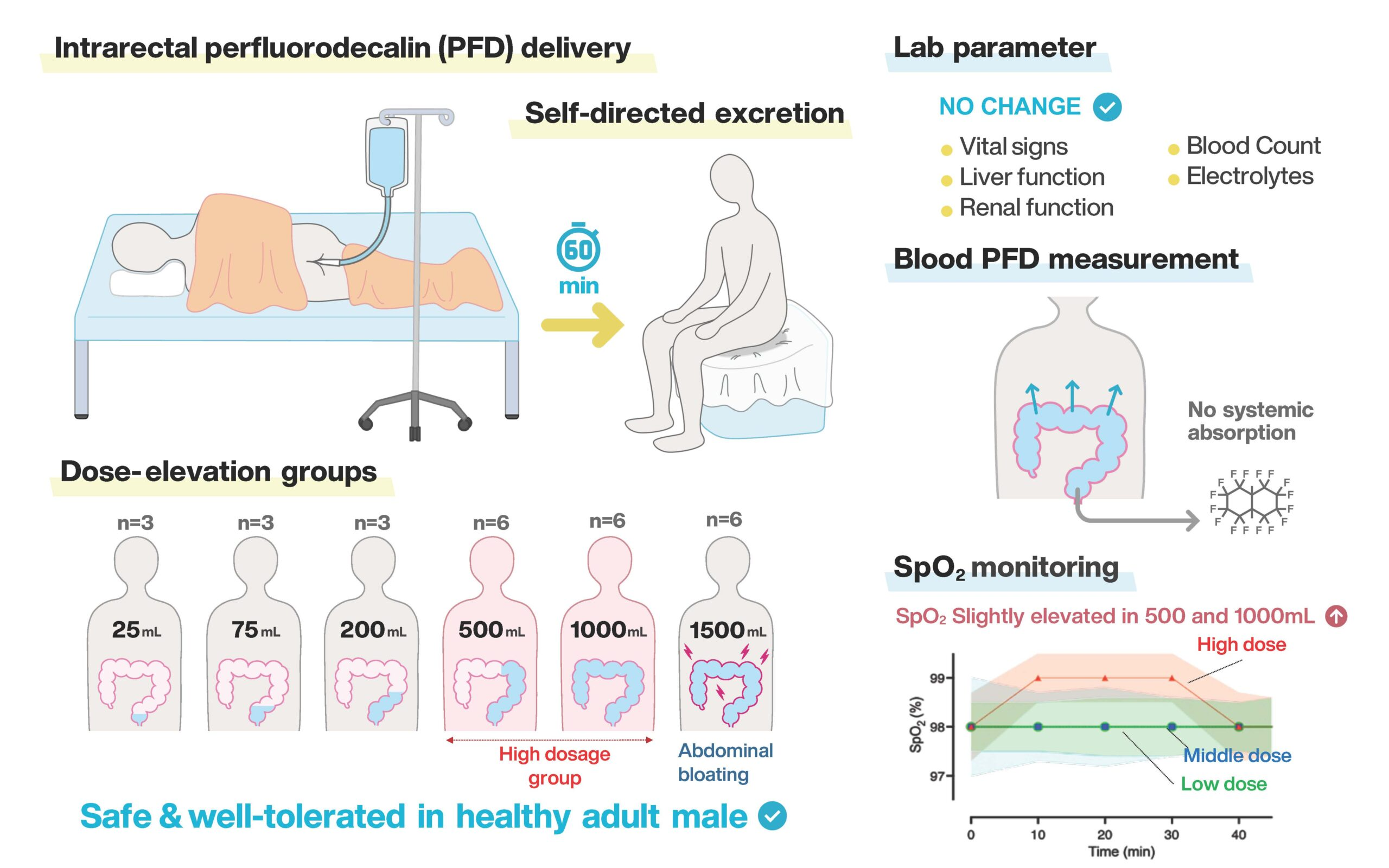
As noted, this was just a safety test, and the perfluorodecalin was not carrying oxygen. Trials using an oxygenated version of the liquid will be next, still on healthy volunteers. If these are similarly successful, the team will move on to those struggling to breathe. They hope the work will be particularly useful for newborns whose lungs are not yet operating properly.
With 1.5 million critically ill adults undergoing tracheal intubation each year in the USA alone, 10-20 percent of whom suffer damagingly low oxygen levels, there is the potential for widespread demand.
Seeing the way influencers try to turn everything into a wellness trend, we do have some concerns, however, and would rather not be around when yoga instructors encourage participants to “breathe out”.
Clinical trials are expensive, and gaining funding is always a struggle, but that challenge has increased exponentially this year. Takebe is taking advantage of the publicity the work attracts to seek funds, and said that the better that goes, the faster research can progress.
The study is published in Med.


 2
2