Humans
 PUBLISHED


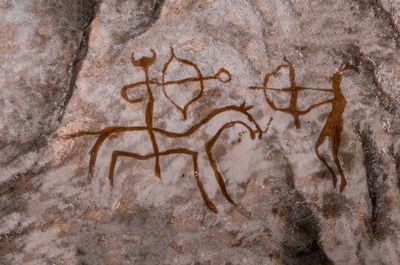


The first Homo sapiens to permanently establish themselves in western Europe may have been carrying some serious heat. Until now, it had been largely assumed that these hunter-gatherer groups killed their prey with darts launched by spear-throwers, but new ballistic experiments indicate that bows and arrows may already have been in use by 40,000 years ago.
Learning about prehistoric weaponry presents a major challenge to scientists since the major components of these hunting tools were made of organic materials that have long-since decomposed. Bows, arrowshafts, and bowstrings, for instance, were fashioned from wood and fiber, with only the projectile points being made of durable materials like bone or stone.
The impact marks left on these lithic and osseous points therefore provide the only clues as to how they were used, yet analyzing these patterns is far from easy. Despite this, researchers generally assume that humans started off with handheld spears before inventing spear-throwers and eventually progressing to bows and arrows.
The first humans to establish themselves in western Eurasia repped the Auragnacian technocultural complex, which remained in vogue throughout the early Upper Palaeolithic, from about 43,000 to 30,000 years ago. Projectile points associated with the Aurignacian have been found across the continent and are generally thought to have been hafted onto darts that were fired using spear-throwers.
To test this assumption, researchers created replicas of bone, antler, and ivory points unearthed at early Upper Palaeolithic sites in Spain, France, and the Czech Republic. They then conducted a total of 191 firing experiments in order to observe the impact marks produced on these osseous armaments when launched from both spear-throwers and bows.
Aiming at deer and sheep carcasses, the study authors found that it was impossible to distinguish between points hafted onto arrows or spears from use-wear patterns alone. This, they say, calls into question all previous assumptions about early Upper Palaeolithic humans relying exclusively on darts and spear-throwers.
“Our results show that we cannot rule out points, which are delivered by bows, when we interpret the osseous projectile points nor assume that all of them were delivered using spear-throwers,” write the researchers. They therefore propose that “Aurignacian hunting gears represent diverse weaponry technologies that possibly include both spear-thrower-and-spear and bow-and-arrows from the onset of the early Upper Palaeolithic.”
To support this argument, the researchers point out that the Aurignacian is marked by an increase in diversity of projectile points, which may reflect a range of different hafting methods and launching systems. They also note that humans began to spread across Eurasia and Oceania at this time, and would therefore have encountered a range of different environments and game resources. This, they say, would have required the development of multiple hunting strategies and weapons.
Taking all of these factors into account, the study authors caution against assumed narratives involving a “linear technological evolution”, arguing instead that Aurignacian hunter-gatherers may have used a variety of hunting weapons simultaneously.
However, the researchers go on to urge caution when interpreting these findings, admitting that “in the absence of direct evidence such as spear-thrower hooks or perishable components of bow-and-arrow technology, it is difficult to infer with certainty the projectile type from the discarded osseous armature alone.”
The study is published in the journal iScience.