Ad

space-iconSpace and Physicsspace-iconAstronomy
clock-iconPUBLISHEDOctober 31, 2024
comments icon1
share110

Humans Just Stared At The Universe. The Universe Is Staring Back

New observations of merging galaxies show a pair of “blood-soaked” eyes.

Dr. Alfredo Carpineti headshot

Dr. Alfredo Carpineti

Alfredo has a PhD in Astrophysics and a Master's in Quantum Fields and Fundamental Forces from Imperial College London.

Space & Physics Editor

Alfredo has a PhD in Astrophysics and a Master's in Quantum Fields and Fundamental Forces from Imperial College London.View full profile

Alfredo has a PhD in Astrophysics and a Master's in Quantum Fields and Fundamental Forces from Imperial College London.

View full profile
EditedbyKaty Evans
Katy Evans headshot

Katy Evans

Deputy Editor-In-Chief

Katy has a BA in Humanities and Philosophy, with over 20 years of experience in online and print publishing. She was named the Association of British Science Writers' Editor of the Year in 2023.

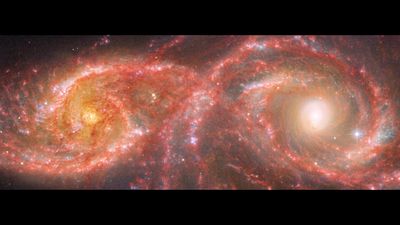
A zoomed in version of the image in the article which is described as such. Two spiral galaxies take the shape of a colorful beaded mask that sits above the nose. The galaxy at left, IC 2163, is smaller, taking up a little over a quarter of the view. The galaxy at right, NGC 2207, takes up half the view, with its spiral arms reaching the edges. IC 2163 has a bright orange core, with two prominent spiral arms that rotate counter clockwise and become straighter towards the ends, the left side extending almost to the edge. Its arms are a mix of pink, white, and blue, with an area that takes the shape of an eyelid appearing whitest. NGC 2207 has a very bright core. Overall, it appears to have larger, thicker spiral arms that spin counter clockwise. This galaxy also contains more and larger blue areas of star formation that poke out like holes from the pink spiral arms. In the middle, the galaxies’ arms appear to overlap. The edges show the black background of space, including extremely distant galaxies that look like orange and red smudges, and a few foreground stars.

The cores of the two galaxies look like a pair of creepy eyes.

Image Credit: NASA, ESA, CSA, STScI


An almost galaxy merger has been caught looking like a pair of eyes staring back at us from the depths of space. NGC 2207 and IC 2163 are a pair of galaxies engaged in the celestial tango that will end up in their eventual fusion into a single object. For the last few million years, IC 2163 has been sliding behind the larger NCG 2207. For now, however, they have only grazed each other.

The rest of this article is behind a paywall. Please sign in or subscribe to access the full content.

The interaction is slight but profound and this is why the combined efforts of JWST and Hubble are perfect for these observations. JWST brought the mid-infrared details while Hubble revealed the visible and ultraviolet. Each wavelength can be used to track star formation in the galaxy pairs, which is being accentuated by the merging process.

Two spiral galaxies take the shape of a colorful beaded mask that sits above the nose. The galaxy at left, IC 2163, is smaller, taking up a little over a quarter of the view. The galaxy at right, NGC 2207, takes up half the view, with its spiral arms reaching the edges. IC 2163 has a bright orange core, with two prominent spiral arms that rotate counter clockwise and become straighter towards the ends, the left side extending almost to the edge. Its arms are a mix of pink, white, and blue, with an area that takes the shape of an eyelid appearing whitest. NGC 2207 has a very bright core. Overall, it appears to have larger, thicker spiral arms that spin counter clockwise. This galaxy also contains more and larger blue areas of star formation that poke out like holes from the pink spiral arms. In the middle, the galaxies’ arms appear to overlap. The edges show the black background of space, including extremely distant galaxies that look like orange and red smudges, and a few foreground stars.
The two gorgeous spirals in all their glory.
Image Credit: NASA, ESA, CSA, STScI

While a galaxy like the Milky Way forms a couple of stars the size of the Sun every year, these galaxies are producing 12 times as many. Our galaxy averages one supernova every 50 years. These two have had seven known supernovae in recent decades. These galaxies are active and the combined observations of JWST and Hubble showcase the activity.

Starbursts spot across the arms that have been twisted by the mutual attraction. The hollows in the red-marked gas are where a supernova has taken place. Spot the bubbling activity across the spiral arms. We are witnessing a snapshot of what will become an incredible merger.

Add us as a Google preferred source to see more of our
trusted coverage in Search