Nature
 PUBLISHED
 1
1


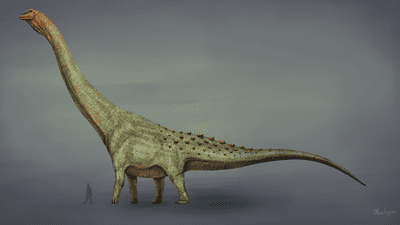


A new species of titanosaur has been unearthed in Patagonia and based on the measurement of its femur, it was an absolute beast. With a thigh bone about the same length as a tall adult human, it’s a rare find and one that’s teaching us that there’s a lot more to learn about a group of dinosaurs known as the Colossosaurians.
This clade of titanosaur sauropods dates back to the Early Cretaceous and their remains have been found across South America. It welcomes a newly discovered species, Chucarosaurus diripienda, that was recently described in a paper following the retrieval of some fossilized remains in the Neuquén Basin, Rio Negro Province, in Patagonia.
The absolute unit of a new titanosaur species would’ve been stomping around during the Late Cretaceous, around 94 million years ago. It fits in well with the Colossosaurians who include most of the truly giant titanosaurs including Argentinosaurus, Notocolossus, Patagotitan, and Puertasaurus.
What’s perhaps surprising about C. diripienda is its comparatively leggy femur that’s quite slender, which, alongside its tibia and ischium (paired bone in the pelvis), show greater morphological variation than previously discovered specimens. It also places the clade in a region it hadn’t been reported in before.
“In spite of being a well-sampled region, up to the date, giant colossosaurs were unknown in Mesozoic deposits from Río Negro province,” lead author Federico Agnolin, a palaeontologist with the Museo Argentino de Ciencias Naturales ‘Bernardino Rivadavia’, told Sci News.
“Chucarosaurus diripienda shows a unique combination of characters indicating that appendicular bones such as the femur, ischium and tibia, show a remarkable morphological variety, greater than previously described, and are morphologically informative as source of phylogenetic data[…] It includes appendicular and relatively slender elements, with a femoral total length of about 1.9 meters [6.2 feet] long.”
Having to work from the incomplete skeletons of just a few taxa makes it difficult for palaeontologists to form broad definitions for the characteristics of certain dinosaurs, which makes finds like C. diripienda an exciting opportunity to try and fill in the gaps. Even if that does sometimes mean just busting the list of opportunities wider open.
“In sum, present finding improves our knowledge on the diversity of Colossosauria,” concluded the study authors, “indicating that distribution and diversification of the clade is far from being satisfactorily known.”
The study was published in the journal Cretaceous Research.