Space and Physics
 PUBLISHED
 1
1



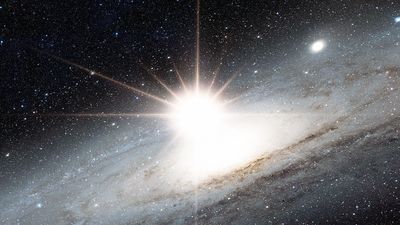


It is obviously unfair that while we wait for Betelgeuse to go supernova (it won’t anytime soon), the good people living during the Early Modern Period had not just one, but two supernovae visible in the night sky: one in 1572 and one in 1604. The explosive death of a star, from a safe distance, is a momentum event, and it is totally unjust that we are very unlikely to experience it.
And you know what makes it even worse? The fact that every second of every day, there are lots of supernovae happening in the universe, just not where we would see them.
The average supernovae rate in the universe is 130 supernovae per second, with a range of as little as 10 and up to over 1,250. Bigger than you’d think, given the fact that they are rare. To get to this number, we need two values. The rate of supernovae per galaxy per century and the number of galaxies in the universe. But estimating these two parameters is more complex than you might think.
Let’s start with the number of galaxies in the visible universe. The volume we are considering spans 93 billion light-years across. Even with the best intentions, supercomputer analysis, and dedicating every single telescope to the task, we wouldn’t be able to count them one by one. So the best we can do is estimate them.
It is possible to estimate the number of galaxies based on observations in certain directions of the sky and then extrapolate them to the whole universe. The latest number, a tad controversial claim based on that method, is that there are 2 trillion galaxies in the universe. Controversial because it seems that if that is the case, these galaxies are not emitting enough light. Measurements from NASA’s New Horizons spacecraft estimated that the universe is too dark for 2 trillion galaxies, with about a tenth of them existing: 200 billion, then.
Now, let’s look at the rate of supernovae. Several estimates focused on the Milky Way, some using historical examples, others the amount of certain radioactive elements present, some other galaxies, and even neutrinos, tiny neutral particles that hardly interact with matter but are produced in abundance in supernovae. They are broadly in agreement that our galaxy experienced maybe one or two supernovae a century.
Is our galaxy representative? Not under certain parameters which may (but may not) come into play in the star formation and then the supernova rate of our galaxy. More conservative estimates talk about a supernova rate of about a tenth of what was estimated for the Milky Way.
This is how we approached our estimate. If there are two supernovae per millennium in your average galaxy and there are at most 200 billion galaxies in the universe, every second, around 13 stars go supernova. If the Milky Way instead is the typical value, and there are 2 trillion galaxies, then we are looking at over 1,270 stars going boom.