Space and Physics
 PUBLISHED
 34
34



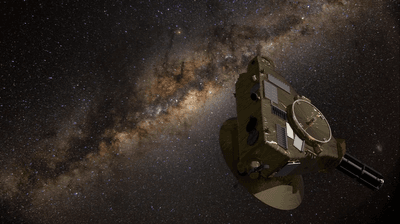


Spacecraft are not like the starships you see in movies. There is no endless supply of dilithium or hypermatter that lets you travel however long you want. Fuel is scarce, and you are bound by orbital mechanics. Still, we are pretty clever at traveling to space and have sent probes to many worlds, and even toward (and then beyond) the boundaries of the Solar System.
Only five probes sent to space have the right speed and orbit that will take them into interstellar space. Voyager 1 and 2 are already beyond the region of influence of the Sun, the first human-made spacecraft to leave our Solar System. Pioneer 10 & 11 are following suit, albeit a bit slower, and then there is New Horizons, which is traveling far beyond Pluto after having met the dwarf planet a decade ago.
When we launch a rocket into space, the first thing that needs to happen for it to be successful is to have enough escape velocity to beat the gravitational pull. For Earth, that is at least 11.2 kilometers per second (about 25,020 miles per hour), without considering the need to overcome air resistance. To make sure a rocket doesn’t burn due to friction, the acceleration is set to increase with altitude.
Getting to that acceleration is not easy because you need to shift a lot of mass, including the mass of the fuel, to get to that acceleration. It is a lot, and so it is unsurprising that we have worked out ways to make it more efficient to go to space, like launching near the equator, where the rotation of the Earth gives you a boost.
Now that our spacecraft has launched, it will need to get even more velocity if it wants to get away from the Sun. Basically, anything that launches from Earth is still carrying our planet’s speed around our star. And that is why we stay in orbit around it. Douglas Adams described flying as the ability to throw oneself to the ground and miss, and that is exactly what objects orbiting other bodies are doing.
Satellites around the Earth are in constant free fall towards our planet, but they move fast enough to miss it. The Earth is in free fall toward the Sun, but due to its speed, it will also fortunately continue to miss it. But as a spacecraft takes flight from Earth, it's useful to use that speed as an advantage. At Earth’s distance, the speed a spacecraft needs to achieve to leave the Solar System with respect to the Sun is just over 42 kilometers (26 miles) per second.
All five of the spacecraft that we have sent on a path to leave the Solar System had more than that speed, with the New Horizons being the fastest. As they move away from the Sun, the gravity of our star has slowed them down, but they are not further away, so their escape velocity is much lower. Basically, there’s no stopping them.
With two already beyond the heliosphere, and the other three hot on their metaphorical tails, getting out of the Solar System is not an easy feat for humanity, but we can certainly do it.