


 Nature
 PUBLISHED


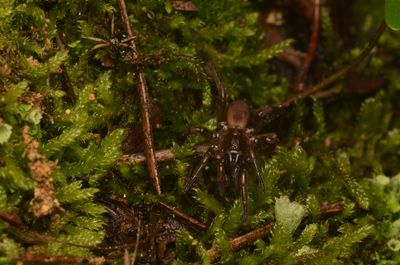


DNA analysis in 2023 confirmed that a trapdoor spider long thought lost to science had been rediscovered in the Portuguese village it was named after, after a 92-year disappearance. Fagilde’s trapdoor spider (Nemesia berlandi) was first described in 1931 before apparently dropping out of existence – but all that changed when an expedition team happened to look under just the right rock.
It marked the 12th “most wanted” lost species to be rediscovered since Re:wild’s Search for Lost Species launched in 2017, which got us wondering: how on Earth does such an epic mission unfold? Fagilde’s trapdoor spider was rediscovered by an expedition team led by the Global Center for Species Survival at the Indianapolis Zoo, where Sérgio Henriques is the resident Invertebrate Conservation Coordinator. We caught up with Henriques to find out just how much work goes into tracking down a missing spider.
How did you start?
SH: We spoke to the local community to get permission to go into their land, and then we picked which parts we wanted to visit based on satellite imagery. We had some idea from other closely related spiders about which habitats they might prefer, usually natural habitats – it’s more likely to find a rare spider in a natural habitat than in the middle of a city.
What did you have to work from?
SH: We knew nothing. We knew where it was [originally] seen, and how it looks, but that was literally it. What we do know, from other trapdoor spiders in the country, and in the world, is that trapdoor spiders live very long lives.
Fagilde’s trapdoor spiders can live very long lives as well. We don't know how long, but what that tells me is once they build a trapdoor, they have their burrow, put a little trapdoor on it, they're not going to move. They're going to stay there until they're disturbed or killed.
So, if you see in a landscape an area that is very disturbed, the spider is not going to be there. That's a very unlikely place because it doesn't have the stability, the safety, doesn't provide that long-term housing.
It's more of an exclusion process than anything else. But in effect, [it involves] being on our hands and knees, looking at the ground. We put ourselves in a position where it's likely, or it's possible, that the spider is there, and then we just look really. It's just a matter of patience, perseverance, and just looking at clues in the environment over and over again. Over a course of hours, days, weeks. We just keep at it until we are lucky.
And you tried some trickery?
SH: Spiders will stay in their burrows except when males need to find a partner. So, what we tried was providing them with artificial shelters out in nature.
Did it work?
SH: No, that failed miserably.
What did work?
SH: We turned to natural shelters. We looked in the soil and we did find some tantalizing evidence: a small trapdoor, some juveniles, but they were abandoned, meaning there was no spider with them, so we couldn’t confirm. But we knew some trapdoors were there, which gave us some momentum. Then, under a natural rock, my colleague turned it and beneath was a damaged burrow.
At the bottom of that burrow was an adult female spider caring for her young, between five and 10. We couldn't see the burrow [from the outside] because she had locked herself inside with silk, and she had covered her own trap door from the inside so that nothing could come in, nothing could come out. There was nothing, no clue of its existence in the outside world. If we hadn't turned that rock, and if that rock hadn't touched that wall slightly, we'd have never seen it.
How did it feel?
SH: So, in my mind, my job at the time was “I need to see what animal made this burrow without hurting it.” That was my priority. That was my only focus. So, I took a long time to dig that burrow, and I did. I succeeded. I didn't kill, didn't hurt, however many of the juveniles or the female.
Then there was a moment where I had to hold that spider. And for many people, that would be a scary proposition. I understand that people are afraid of a myriad of things, but that spider, in my hand – at that time – was probably the only animal of that species ever to be seen in 100 years. So, the sheer amount of responsibility, of duty, of diligence one has to put into that moment is very hard to explain.
How long did the rediscovery take?
SH: It took us a decade to find it.
Listen to the full conversation here.
This Q&A first appeared in Issue 26 of our digital magazine CURIOUS. Older issues of CURIOUS are free for all users. To access new issues, become an All Access Member. You can find more episodes of We Have Questions wherever you get your podcasts.



 1
1