Space and Physics
 PUBLISHED
 1
1



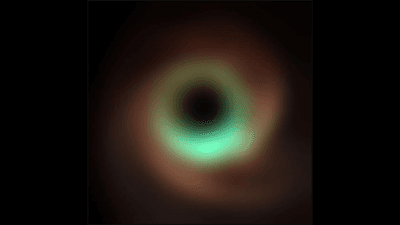


The Event Horizon Telescope (EHT) made history over the last several years by delivering the first images of the shadows of two supermassive black holes. The fuzzy orange glow might look out of focus, but it was a technical feat, requiring connecting telescopes all around the surface of the planet to form a single instrument the size of the Earth. It had a resolution so high that in optical it would see a bagel on the surface of the Moon. Now, the team knows how to push the resolution higher.
Combining telescopes in Spain, Hawai’i, and Chile, including the Atacama Large Millimeter/submillimeter Array (ALMA), the team was able to measure signals in the universe at a frequency of 345 GHz. They believe that they can now improve the precision of the supermassive black hole images by at least 50 percent.
"With the EHT, we saw the first images of black holes by detecting radio waves at 230 GHz, but the bright ring we saw, formed by light bending in the black hole’s gravity still looked blurry because we were at the absolute limits of how sharp we could make the images," paper co-lead Alexander Raymond, from NASA’s Jet Propulsion Laboratory, said in a statement. "At 345 GHz, our images will be sharper and more detailed, which in turn will likely reveal new properties, both those that were previously predicted and maybe some that weren't."
There is yet to be an image made with the approach tested here, as there were too few instruments to get something decent out. They could measure details 19 microarcseconds apart. That means that you could see an object just slightly larger than a half dollar on the surface of the Moon. The breakthrough is so exciting, that the team is certain it will bring forth new discoveries.
"To understand why this is a breakthrough, consider the burst of extra detail you get when going from black and white photos to color," said paper co-lead Sheperd "Shep" Doeleman, an astrophysicist at the CfA and SAO, and Founding Director of the EHT. "This new 'color vision' allows us to tease apart the effects of Einstein’s gravity from the hot gas and magnetic fields that feed the black holes and launch powerful jets that stream over galactic distances."
A paper describing the results is published in The Astronomical Journal.