Space and Physics
 PUBLISHED


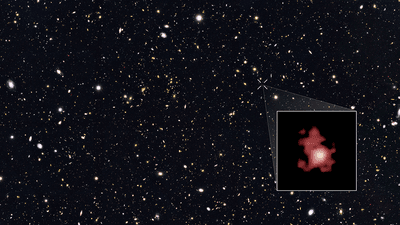


Observing a galaxy in the distant cosmos using the JWST, two teams of astronomers believe they may have spotted some of the earliest bodies in the universe, the elusive and as-yet-hypothetical "Population III stars".
In the current age of the universe, around 74 percent of the baryonic matter (or visible matter) is hydrogen, about 24 percent is helium, with the final 2 percent being made up from every other element on the periodic table. According to what we know of the universe (so far), in the early years of the universe those heavier elements (which astronomers refer to as metals) had not formed yet. Instead, the first stars were formed from pristine clouds of hydrogen and helium, as well as trace amounts of lithium also thought to form during the Big Bang. It is only when these stars exploded as supernova that we got all those other elements we know and love (shoutout to gallium) in the mess.
Those first stars, known as Population III stars, have been modeled by scientists for decades. They are thought to be extremely massive – possibly 10-1,000 times the mass of the Sun – and, of course, completely lacking in the heavier elements. They aren't thought to have lived too long either, burning through their fuel in just a few million years, far shorter than stars in the current age of the universe. Spotting such stars would help us know whether our models of the universe are on the money, as well as whether our models of early universe galaxy formation are on the right track.
So far, we have a few promising candidates, though no confirmation. In two new preprint papers, astronomers have gathered further evidence that one candidate may be the real deal.
In 2024, a team led by Professor Roberto Maiolino found signs of a pristine cloud of gas surrounding the galaxy GN-z11, which was the most-distant galaxy ever observed when it was first found in 2016.
"The fact that we don't see anything else beyond helium suggests that this clump must be fairly pristine," Maiolino said in a statement at the time. “This is something that was expected by theory and simulations in the vicinity of particularly massive galaxies from these epochs — that there should be pockets of pristine gas surviving in the halo, and these may collapse and form Population III star clusters.”
They also found another intriguing piece of evidence, a faint emission line coming from a companion object – named Hebe – matching doubly ionized helium, or HeII (we know it looks like "hell", but those last two letters are "i" and denote that He is doubly ionized). Extreme conditions, such as those thought to occur in Population III stars, are needed to create HeII, and so the team tentatively proposed that may be the cause.
Now, new and higher-resolution observations have shown the same emission lines. Meanwhile, a second team has observed Hebe, with both teams finding no other heavier elements, suggesting it could really be caused by those elusive first stars. The teams looked for other possibilities, including primordial black holes and Wolf-Rayet stars, but none of these fit the data as well.
"We have [...] explored the possibility of a Direct Collapse Black Hole or a Primordial Black Hole. However, these scenarios face significant issues," the team explains in their paper, adding, "the only models consistent with the observed EW(HeII) and HeII/H𝛾 ratios are those involving PopIII stars. Further constraints supporting this scenario come from modelling the non-detection of metal lines."
In the second paper, the team attempted to estimate the mass of these objects, finding that between 10 and 100 times the mass of the Sun was the best fit. Further work will of course be needed to see what exactly we are looking at, but so far the signs are promising.
"Hebe represents one of the most convincing pieces of evidence for Population III stars in the early Universe, and its properties support models of their formation and early evolution," the authors added.
The first study is posted to preprint server arXiv. The second is also posted to arXiv.