Culture and Society
 PUBLISHED
 3
3


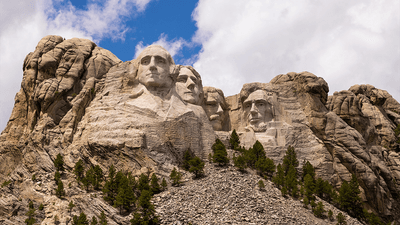


Back in 1923, the superintendent of the South Dakota State Historical Society, Doane Robinson, began dreaming of a giant monument, carved into rock, which would draw visitors to South Dakota.
Robinson petitioned anybody who would listen to him, raising interest in his campaign to place giant statues of figures such as Red Cloud, leader of the Oglala Lakota in South Dakota, explorers Lewis and Clark, and members of the Sioux, on the South Dakota skyline. He took the idea to US Senator Peter Norbeck, who, in turn, began seeking a sculptor for the project.
Gutzon Borglum, a prolific American sculptor with white supremacist leanings and ties to the Ku Klux Klan, took the project on, but insisted on a few minor tweaks to the heads. Instead of local figures, he wanted to carve the heads of presidents of the United States into rock, representing the most important events in the United States to that point, controversially placing them on land considered sacred by local Native Americans.
There were a few easy picks for faces to represent the nation's history, for Borglum, at least. No collection of massive heads would be complete without George Washington, the first president of the US, nor Abraham Lincoln, who led the nation during the Civil War. Thomas Jefferson, who was the primary author of the Declaration of Independence, was chosen to represent the growth of the United States, while Theodore Roosevelt, who negotiated the construction of the Panama Canal, was chosen to represent its development.
Construction began on October 4, 1927, and wasn't completed until October 31, 1941. It was pretty grueling and dangerous work, with around 90 percent of the mountain being carved with good old-fashioned dynamite.
"The workers had to endure conditions that varied from blazing hot to bitter cold and windy. Each day they climbed 700 stairs to the top of the mountain to punch-in on the time clock," the National Park Service explains. "Then 3/8 inch thick steel cables lowered them over the front of the 500-foot face of the mountain in a 'bosun chair'. Some of the workers admitted being uneasy with heights, but during the Depression, any job was a good job."
Construction did not quite go to plan. Originally, Borglum wanted to create a large inscription describing the nine most important events in American history to go alongside the sculptures.
"This plan failed for two critical reasons. First, the text could not be made large enough to read at such a great distance," the NPS explains. "Also, after relocating the Jefferson head, that section of the mountain was needed for the Lincoln head."
With this plan foiled by needing space for Lincoln's big old head, Borglum intended instead to place a grand room within the mountain, hidden behind Lincoln. After ascending a staircase leading to the hidden room, dubbed the Hall of Records, visitors would be met with a giant bronze eagle and the words "America’s Onward March" inscribed overhead.
This plan didn't go too well either. Between July 1938 and July 1939, workers began blasting a tunnel into the mountain. But with Congress unwilling to spend funds on the Hall of Records, ordering Borglum to focus on the figures, the tunnel remained pretty rough-cut and tapered off towards the back. After his death in 1941, and the US entering World War II, construction on the hall and the monument in general ceased.
The idea had been that the Hall of Records would contain permanent records of American history inside bronze and glass cabinets, including the Constitution and the Declaration of Independence, as well as lists of achievements by the US in science and the arts. That did not happen, but in 1998, a repository of records was placed inside the Hall of Records. A teakwood box inside a titanium vault was placed on the floor in the hall entry, before being covered with a granite capstone. On the capstone, inaccessible to visitors to Mount Rushmore, are Borglum's own words:
"Let us place there, carved high, as close to heaven as we can, the words of our leaders, their faces, to show posterity what manner of men they were. Then breathe a prayer that these records will endure until the wind and rain alone shall wear them away."
The box has been left as a time capsule for people thousands of years in the future who may wonder why Mount Rushmore was carved.