Space and Physics
 PUBLISHED
 2
2



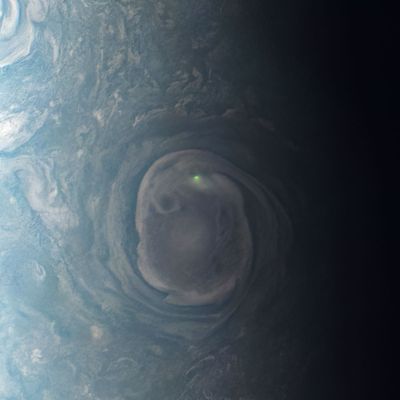


Lightning is not exclusive to Earth, it is found in several other places in the Solar System, but some of the most spectacular is found on the largest planet. Jupiter has an atmosphere of swirling clouds and enormous storms within which lightning can strike – and sometimes we are lucky enough to catch it.
This image just released by NASA was captured by Juno during its 31st flyby of the gas giant on December 30, 2020, and processed by citizen scientist Kevin M. Gill from raw data from the JunoCam instrument on board. The spacecraft was 32,000 kilometers (19,900 miles) above Jupiter's clouds near the north pole at 78 degrees of latitude when it captured the green bolt.
The color of the lightning is certainly peculiar, being bright green. This might be an artifact of the color processing, though lightning can be colorful. Atmospheric particles can alter the colors. This is often seen on Earth in volcanic lightning, where the effects of ash can add tints of blue, purple, and lilac. Maybe an analogous effect is at work here on Jupiter.
The principle of lighting is the same on Earth and Jupiter, as powerful electrical discharges spread through clouds, but the formation is slightly different. On Jupiter, the clouds are a mixture of ammonia and water, and most lightning happens at the poles, while on Earth, the clouds are made of water vapor and lightning usually strikes more at the equator. The lightning capital of the world, Catatumbo in South America, receives 1.6 million lightning strikes a year.
In the coming months, more images of Jupiter’s lightning are expected as Juno's orbit will allow for close passages over Jupiter’s night side where these electric weather events can be more easily spotted.