Space and Physics
 PUBLISHED
 2
2


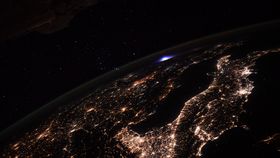


European Space Agency astronaut Thomas Pesquet has shared a stunning photo of the Earth at night taken while the International Space Station (ISS) flew over Italy. But "lo stivale" – the "boot" of Italy – is not the most interesting feature. In the distance, we can see a rare transient luminous event (TLE) happening in the atmosphere.
There are many types of colorful upper-atmosphere lighting, which is what TLEs are. Based on the color of this one, the event might have been a rare blue jet or blue glimpse. These lightning-like electrical discharges shoot from the tops of thunder clouds up to 50 kilometers (30 miles) into the stratosphere and last mere milliseconds.
They are usually hard to see from Earth, due to the storm clouds, and our atmosphere, getting in the way. The ISS, however, is equipped with the Atmosphere-Space Interactions Monitor (ASIM), which reports the most peculiar electrical events that happen high above the clouds. It has spotted some extraordinary events over the years.
“This is a very rare occurrence and we have a facility outside Europe's Columbus laboratory dedicated to observing these flashes of light. The Space Station is extremely well suited for this observatory as it flies over the equator where there are more thunderstorms,” Pesquet wrote in the photo's caption.
“My friend Andreas Mogensen has a large part to play in this story, he was the first to capture them from space (in only 10 days on the Space Station he did all this, legend!) proving the worth of having a facility to monitor the flashes!'”
For decades, these TLE events had little evidence supporting them. There were anecdotal reports from pilots but not much that scientists could go on. Now we know a whole bunch of these unusual types of lightning – jets, sprites, and elves – exist. Using the ISS to study the upper atmosphere has allowed us to capture incredible data to better understand this previously unexplored dimension of thunderstorms. We've even seen them frolicking on other planets.