Space and Physics
 PUBLISHED


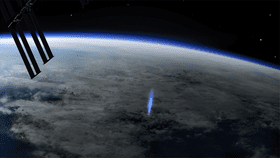


With the crash of thunder usually comes a flash of lightning, a bright jagged streak zipping from cloud to Earth via the shortest route possible. But did you know lightning sometimes shoots straight up instead? Oh, and it’s blue.
“Blue jets” – lightning-like electrical discharges that shoot from the tops of thunder clouds up to 50 kilometers (30 miles) into the stratosphere, and lasting mere milliseconds – are rare but not unheard of. We usually don’t get to see them, as the clouds that form a thunderstorm, and the atmosphere that protects us from radiation, obscure our view from the ground. Not so, for the weather observation equipment on the International Space Station (ISS). Looking down on Earth’s weather from 400 kilometers above offers a front-row view.
Now, using the European Atmosphere-Space Interactions Monitor (ASIM) on the ISS, researchers have documented five intense 10-millisecond blue flashes, one generating a pulsating “blue jet” that shot into the stratopause (the boundary between the stratosphere and the mesosphere), generating the glowing disk of optical and UV light known as "elves".
The ASIM observatory – often referred to as "storm hunter" – was installed on the ISS in 2018 with the aim of documenting electrical discharges from storms up above the cloud tops, and now it's met its purpose, with the researchers publishing their findings in the journal Nature.
We only confirmed the existence of these unusual types of lightning – jets, sprites, and elves, collectively known as transient luminous events (TLEs) – in the early 1990s, when a video of a sprite was accidentally caught on camera. A couple of years later red sprites and blue jets were confirmed by video observations from NASA's Space Shuttle, followed up by the discovery of elves (necessarily short for Emission of Light and Very Low-Frequency perturbations due to Electromagnetic Pulse Sources). All these phenomena are super bright but last just milliseconds, so observing and studying them is hard.
In 2015, ESA astronaut Andreas Mogensen was tasked with the experiment known as Thor (after the Norse god of thunder), to capture thunderstorms from the ISS, using a new thundercloud imaging system. His photos of the blue jets and flashes led to the ASIM storm hunter being installed on the space station in 2018.

Capturing these phenomena is difficult but vital in our study of weather systems on Earth. Researchers suspect they could even influence the concentrations of greenhouse gasses in Earth's atmosphere, so understanding how lightning forms in clouds could help us mitigate our planet's CO2 emissions. Plus, they look really, really cool.