Space and Physics
 PUBLISHED
 2
2


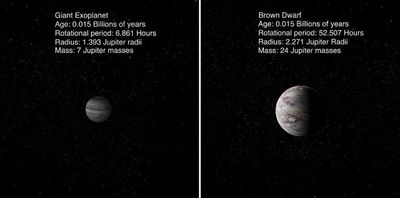


It is difficult to distinguish between the largest planets and the smallest brown dwarfs, stellar objects that were never massive enough to undergo nuclear fusion. Brown dwarfs tend to be heavier (between 13 and 80 times the mass of Jupiter), but some planets can be larger. Ideally, you’d want to know if they formed like a planet or like a star to put each object in the right box. Researchers now might have a way to do that. It’s about spin.
Planets form from the aggregation of material within a protoplanetary disk that surrounds a star. This formation happens with a lot of interaction between the planet and the disk. On the other hand, brown dwarfs form like stars from the fragmentation of a large gas cloud into small clumps.
In either scenario, the object that forms will possess some angular momentum. They will have spin and rotate around an axis. In the spin, there is an indication of how they formed. When mass, size, and age are taken into account, gas giant planets spin faster than brown dwarfs.
“Spin is a fossil record of how a planet formed,” lead author Dino Chih-Chun Hsu, a researcher at Northwestern University, said in a statement. “By measuring how quickly these worlds rotate, we can start to piece together the physical processes that shaped them tens to hundreds of millions of years ago.”
The team conducted detailed observations of 32 objects between brown dwarfs and giant planets, all orbiting stars, as well as looking at properties of isolated brown dwarfs and large free-floating planets.
“Our results suggest that both the planet’s mass and the ratio between the planet’s mass and its star’s mass influence how fast the planet ultimately spins,” said Hsu. “That helps us narrow down the physics of how these systems form.”
Many worlds considered in this study orbit well beyond where the planets in the Solar System do. Still, the spin and the interactions with the protoplanetary disk must have happened here, too. Understanding those factors allows us to better understand why our corner of the universe is the way it is.
“The way that angular momentum is distributed among planets influences the overall architecture of a planetary system,” said Hsu. “Even Earth’s rotation and magnetic field ultimately connect to how that spin budget was divided when the solar system formed.”
The study is published in The Astronomical Journal.