Nature
 PUBLISHED


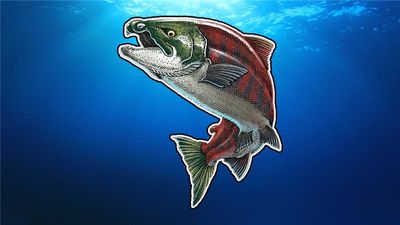


Around five million years ago, the rivers of North America were home to an enormous salmon that would make today’s largest specimens look like minnows. It may have grown up to 8.9 feet (2.7 meters) long and was thought to have incredibly long fangs like a saber-toothed tiger. However, new research has found that this was not the case. Rather than a saber-toothed salmon, the fish actually had spike-like tusks similar to warthogs today.
The monster salmon, Oncorhynchus rastrosus, was first described in the 1970s and is thought to be the largest member of the Salmonidae family to have ever lived. At the time of its discovery, researchers assumed that it had two oversized front teeth that pointed backward into its mouth like fangs. This was mostly because the fossil fragments they were working with were damaged – the teeth were found separate from the skulls. They therefore based their thinking on current salmon anatomy and other animals of that era.
As such, O. rastrosus has traditionally been known as the “saber-toothed salmon”, but this was a red herring.
Having examined fossils recovered in 2014, researchers have now determined that O. rastrosus toothy protrusions actually faced outwards, like tusks. So the saber-toothed salmon is no more. All hail the “spike-toothed salmon.”
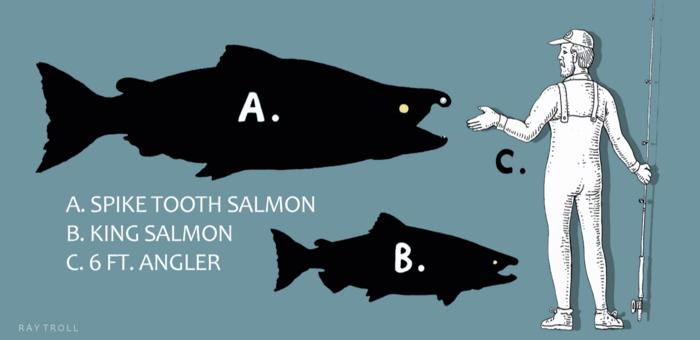
“I’m delighted that we have been able to put a new face on the giant spike-tooth salmon, bringing knowledge from the field in Oregon to the world,” Edward Davis, associate professor of earth sciences at the University of Oregon and director of Condon Collection at the UO’s Museum of Natural and Cultural History explained in a statement.
Despite this revelation in tooth orientation, it is still unclear what these tusks were actually used for. The researchers believe they were most likely used for fighting, either to duel other spike-toothed salmon or to defend against predators. This would have been particularly useful for the fish as they swam upstream to spawn – then as now, this journey would have been perilous for many.
It is also possible that the tusks had multiple purposes, they may have also been used to dig nests and to defend them from other salmon looking to sneak in themselves.
However, the team doubts the teeth were used for hunting prey. This is because O. rastrosus is thought to have been a filter feeder that fed on plankton. So a giant fish using tusks to eat tiny organisms drifting in water would be like use using a wrecking ball to make a salad.
“We have known for decades that these extinct salmon from Central Oregon were the largest to ever live,” Kerin Claeson, professor of anatomy at Philadelphia College of Osteopathic Medicine added.
“Discoveries like ours show they probably weren't gentle giants. These massive spikes at the tip of their snouts would have been useful to defend against predators, compete against other salmon, and ultimately build the nests where they would incubate their eggs."
Interestingly, it seems these tusk-teeth were present on both male and female salmon, which means, as Brian Sidlauskas, professor and curator of fishes at Oregon State University, notes “the sexes were equally fearsome.”
O. rastrosus went extinct over five million years ago when the oceans cooled, but their biology tells us a great deal about habits that may appear in the next hundred years as climate change continues. If things continue as they are, it is possible we will see warm oceans similar to those that were home to the spike-toothed salmon.
The paper is published in the journal PLOS ONE.