Humans
 PUBLISHED
 1
1


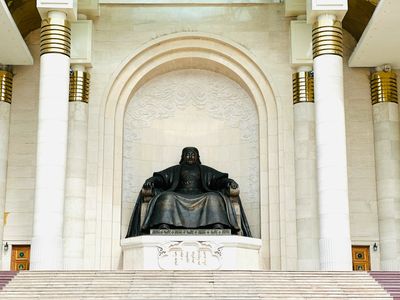


The remains of Genghis Khan, one of the most influential humans in history, have never been found. Nearly 800 years have passed since his death, but his tomb remains undiscovered. And perhaps, some would argue, it should stay that way.
When Genghis Khan (AKA Chinggis Khaan) died in 1227 CE, he had planted the seeds of what would become the largest contiguous land empire in history: the Mongol Empire. Millions upon millions would perish in its making, but his conquests also laid the path for an unprecedented era of commercial and cultural exchange across a vast band of Eurasia.
How did Genghis Khan die?
Despite the magnitude of his legacy, many details about the man himself have been lost to history, including the circumstances of his death.
Theories range from infectious disease and battlefield injuries, to horseback riding accidents and lightning strikes. One of the more outlandish suggestions is that he succumbed to blood loss after being castrated by a Tangut princess who had concealed a devilishly sharp device in her vagina.
Curse of the Khan
Whatever the cause of death, widely touted folklore holds that his body was returned to his birthplace on the sacred peak of Burkhan Khaldun in the Khentii Mountains of northeastern Mongolia.
Legend has it that soldiers who built his tomb killed everyone they encountered along the funeral procession route. Those soldiers then killed themselves, ensuring that no living soul could ever reveal where he was buried. This is as top secret as it gets.
Another legend goes further still and claims the tomb was sealed with a curse. Should his earthly remains ever be discovered, it would trigger the end of the world.
As all these tales suggest, there’s a lot of noise in this story. But even setting the folklore aside, some scholars remain unconvinced by the Burkhan Khaldun theory. Besides anything else, it would be tricky to prove. Thanks to its association with the empire's great founder, Burkhan Khaldun is a sacred site in local belief and remains heavily controlled by the Mongolian government. Trowel-wielding archaeologists would be unlikely to receive a warm welcome.
Even if archaeologists were to look elsewhere, it would prove difficult. The Mongolian steppe is a vast open expanse, most parts of which are undeveloped and poorly connected. Traversing this boundless terrain requires tons of preparation and localized knowledge, not to mention some decent horseback riding skills.
Attempts to find the tomb
Claims of the tomb's discovery are nothing new. In 1927, it was reported that a Russian archaeologist had discovered the tomb of Genghis Khan near the ruins of the dead city of Khara-Khoto, in the Gobi Desert. There have been countless similar claims over the past century, most of which historians have greeted with raised eyebrows.
More recently, scientists have tried to use more modern technologies to find the location. In a 2014 paper published in the journal PLOS One, researchers asked over 10,000 people online to pore over satellite imagery of Mongolia and identify possible sites of Genghis Khan’s tomb. The research turned up 55 potential sites of archaeological significance, although none have yielded the remains or tomb of Genghis Khan.
Perhaps it should stay this way. If the legend is anything to go by, Genghis Khan clearly wanted to keep his burial place a secret. And given the number of people who died at his hands, that wish seems worth respecting.