Space and Physics
 PUBLISHED
 9
9



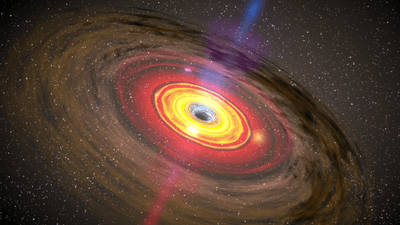


At the center of almost every galaxy, there is a supermassive black hole. Most of the enormous objects live a quiet existence – but they occasionally get active, with an accretion disc surrounding them and feeding them. Within that disc, much smaller black holes can interact, and even end up in traffic jams.
New work aims to understand the environment within these accretion discs and how they could be conducive or not to collisions between stellar-sized black holes. The gas in the discs and these black holes interact in intriguing ways which cause those extremely dense objects to migrate towards particular zones.
Researchers are calling these intersections "migration traps". That’s where the black hole traffic jams happen. As the stellar black hole population in those regions increases, so does the chance of collisions. But those traps are quite susceptible to the properties of the supermassive black hole, and the most active black holes seem unlikely to have those traps.
"We looked at how many and where we’d have these busy intersections. Thermal effects play a crucial role in this process, influencing the location and stability of migration traps,” lead author Dr Evgeni Grishin, from Monash University, said in a statement. "One implication is that we don’t see migration traps occurring in active galaxies with large luminosity."
Supermassive black holes and their accretion disks are a major focus in astrophysics. They often are so bright to match the luminosity of their host galaxy, which has earned them the name of active galactic nuclei (AGN). But they are not just bright – they shape the evolution of their galaxies. So understanding the intricacies of their structures helps understand how they might have an impact further afield.
It’s not just about the big black holes. The little ones matter too. Gravitational wave astronomy is currently sensitive to the collision of the stellar-sized ones, and finding out environments where those can happen more often is incredibly exciting. Still, there’s more work to be done.
“Despite these significant findings, much about the physics of black holes and their surrounding environments remains unknown,” Dr Grishin continued. “We’re thrilled with the results, and we now are one step closer to discovering where and how black holes merge in galactic nuclei. The future of gravitational wave astronomy and active galactic nuclei research is exceptionally promising.”
The work is published in the Monthly Notices of the Royal Astronomical Society.