Nature
 PUBLISHED


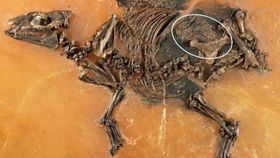


The oxygen-depleted lake that has created one of the great treasure troves of ancient animal specimens has released one more: an exceptionally well-preserved horse ancestor that was pregnant with a foal. The find includes only the second scientifically recorded fossilized placenta.
Eurohippus messelensis was just the size of a fox, but its descendants grew to be the mighty horses of today, with a little help from selective breeding over the five thousand years. The species was named for the Messel oil shales in which a rich variety of animals were buried between 57 and 36 million years ago.
In 2000, an almost complete E. messelenis skeleton was found in those shales at a level laid down 47 million years ago, but it is only now that the value of the find has become clear. Along with the mother horse, the shale pit preserved the bones of a fetus. “Almost all of the bones of the fetus are still articulated in their original position. Only the skull is crushed," said Dr. Jens Lorenz Franzen of the Senckenberg Research Institute.
Even more remarkably, micro X-rays of the specimen has revealed parts of the uterine tissue and what is known as the “broad ligament,” a structure that in modern horses supports the fetus by linking the uterus to the mother's backbone. The fetus had fully developed teeth, indicating it was almost ready to be born, but had not yet turned into the birthing position. This is the first evidence that ancient horses gave birth in the same way their much larger descendants do.
The preservation is a result of the same conditions that killed the unfortunate mare and the many other animals at what was then Lake Messel. The area at the time was volcanic, and gasses overcame animals that ventured to the water to drink. The bottom of the lake had no oxygen, so the bacteria that decomposed the soft tissues were anaerobic and precipitated iron from the lake water, leaving a metallic trace of the shape of some of the tissues. Even the outline of the mare's final meal can be made out.
Franzen presented his work to the 2014 annual meeting of the Society of Vertebrate Paleontology. He told Live Science the preservation is so remarkable he can see, “tips of hairs of the outer ears—even the interior, like blood vessels, become visible in some cases."