Space and Physics
 PUBLISHED


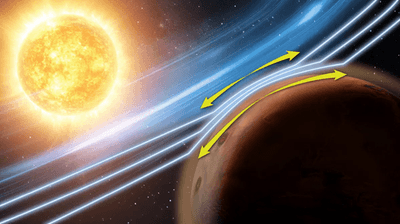


In a first for a world beyond Earth, the weak Martian magnetic field induced above Mars’ day side has proven strong enough to reshape the movements of charged particles from the Sun, in a way that that has been compared to toothpaste squeezed out of a tube.
Fifty years ago, two physicists named BJ Zwan and RA Wolf created a mathematical model that described the way plasma from the solar wind should be squeezed along magnetic field lines between the surface of a planet and the bow shock created by its passage through the wind. Although there were no solid constraints, Zwan and Wolf referred to “magnetic flux tubes” through which the plasma would be squeezed. They predicted a depletion layer with very little plasma just outside the planet’s magnetosphere, since shown to involve about half the surrounding plasma density in Earth’s case.
The phenomenon was named the Zwan-Wolf Effect, and subsequently observed protecting the Earth, but had never been seen anywhere else until three years ago.
Earth’s magnetosphere is so large that the Zwan-Wolf Effect is seen tens of thousands of kilometers above the planet. Mars, however, has no planet-wide magnetic field, although it probably did once. Nevertheless, Mars does have localized magnetism, and the ionosphere, caused both there and here by solar radiation stripping electrons from atoms, interacts with the solar wind to create an induced magnetic field.
Since the Martian magnetosphere is the product of interactions with the solar wind, rather than the behavior of the planet’s core, it’s highly varied, depending on solar activity. When a large solar storm hit Mars in December 2023, Christopher Fowler, a research assistant professor at West Virginia University in Morgantown, was studying observations taken by NASA’s Mars Atmosphere and Volatile Evolution (MAVEN) and noticed something unfamiliar.
“When investigating the data, I all of a sudden noticed some very interesting wiggles,” Fowler said in a statement. “I would never have guessed it would be this effect, since it’s never been seen in a planetary atmosphere before.”
Fowler and colleagues initially could not identify the cause of what they were seeing, and compared observations during the storm with those at other times, turning up more surprises, such as unexpectedly high ion temperatures. After ruling out several explanations, the team concluded the Zwan-Wolf effect explained everything in MAVEN’s measurements, but at a very different location.
MAVEN’s orbit is very elliptical, from 180 kilometers (112 miles) above the Martian surface up to 4,500 kilometers (2,800 miles). When over the dayside of Mars, MAVEN flew through the squeezed plasma, even at the lowest part of its orbit, showing the effect extends down to where the outermost parts of the thin Martian atmosphere extend.
“No one expected that this effect could even occur in the atmosphere,” said Fowler. “That’s what makes this even more exciting. It introduces interesting physics that we haven’t yet explored and a new way the Sun and space weather can change the dynamics in the Martian atmosphere.”
Although MAVEN only detected signs of the Zwan-Wolf effect when the storm hit Mars, Fowler and co-authors think it happens constantly, but at levels too low for MAVEN’s sensitivity.
There’s only one rocky body in the Solar System with a planetary magnetic field, but four with atmospheres, so the presence of a Martian Zwan-Wolf effect means we should look out for something similar on Venus and Titan.
The discovery is also relevant for knowing how Mars responds to major solar storms, which could be important for future settlements. “Knowing how space weather interacts with Mars is essential,” said Shannon Curry, principal investigator of MAVEN and research scientist at the Laboratory for Atmospheric Space Physics at the University of Colorado Boulder.
Signals from MAVEN were lost in December 2025, and NASA is uncertain whether it is still operating, but the processing of the interpretation of collected data goes on. “The MAVEN team continues making new discoveries with our datasets and finding these links between our host star and the Red Planet,” Curry added.
The study is published in Nature Communications.