


 Space and Physics
 PUBLISHED



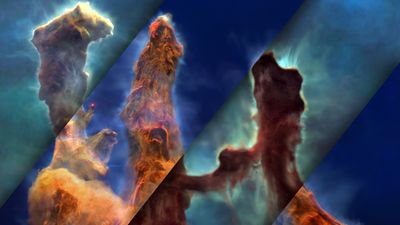


When we look at things in astronomy, we see them projected onto the vault of heaven. Often we cannot appreciate that they are three-dimensional structures spanning mind-boggling distances. But combining observations at different wavelengths with cutting-edge visualization tools let us bridge that gap. The latest beautiful example focuses on the Pillars of Creation.
These finger-like gas clouds are actually light-years-long structures. In them, stars are being born, something that the keen eye and infrared capabilities of JWST have been able to show. Infrared can pass through some of the gas and dust. While the Pillars are all part of the Eagle Nebula, located 6,500 light-years away, they are not in the apparent alignment we see them in.
"By flying past and amongst the pillars, viewers experience their three-dimensional structure and see how they look different in the Hubble visible-light view versus the Webb infrared-light view," principal visualization scientist Frank Summers of the Space Telescope Science Institute (STScI) in Baltimore, who led the movie development team for NASA's Universe of Learning, said in a statement. "The contrast helps them understand why we have more than one space telescope to observe different aspects of the same object."
The gas and dust clouds are being eroded from within and without. Intense ultraviolet starlight from young stars is dispersing the gas and dust. Hubble and JWST have the capabilities to catch light from ultraviolet to mid-infrared to deliver incredible insights into this fascinating celestial object.
"When we combine observations from NASA's space telescopes across different wavelengths of light, we broaden our understanding of the universe," added Mark Clampin, Astrophysics Division director at NASA Headquarters in Washington. "The Pillars of Creation region continues to offer us new insights that hone our understanding of how stars form. Now, with this new visualization, everyone can experience this rich, captivating landscape in a new way."
Creating these visualizations in 3D required the building of a virtual model of the pillars, and NASA has made a 3D printable model of the Pillars of Creation available free of charge. This could be a nice thing to print for space lover, and it could be useful in astronomical discussions with people with visual impairments, similar to the work done by the team at Tactile Universe.


 1
1