Nature
 PUBLISHED
 2
2


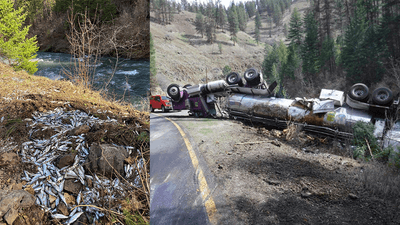


A fish tanker truck transporting around 102,000 young Chinook salmon smolts overturned on the way to the Imnaha River on March 29. While you might think that that would be the end of all of the salmon on board, the fish did something rather extraordinary and began leaping into the nearby creek.
The truck, which was 16 meters (53 feet) long, overturned after going around a sharp turn and skidding, causing it to hit a rocky embankment and roll onto its roof. The driver received minor injuries according to a statement by the Oregon Department of Fish and Wildlife (ODFW). However, the salmon were the real survivors of the accident, with 77,000 leaping and flapping their way into the nearby Lookingglass Creek.
The spring Chinook salmon (Oncorhynchus tshawytscha) were being transported to the Imnaha River for sport harvest and to supplement the wild population. They are the largest of all the Pacific salmon types and were raised by the Lookingglass Hatchery.
Salmon have an extraordinary life, with young salmon hatching in freshwater streams before eventually swimming out to the saltwater ocean. After a few years at sea, the salmon will return to the streams in which they hatched to spawn and then die. The salmon on the tanker were about 18 months old and were due to be introduced to the streams before beginning their 1,046-kilometer (650-mile) journey to the Pacific, the New York Times reports.
After three years at sea, these salmon will return to the same rivers to breed. “They kind of smell their way back,” Andrew Gibbs, the ODFW's fish hatchery coordinator for eastern Oregon, told the New York Times. “It’s an incredible life history.”
The ODFW think that around 20 percent of the total smolts on the truck were lost in the accident, while approximately 77,000 leapt into the nearby Lookingglass Creek, a tributary of the Grande Ronde River, when the tanker fell.
Some of the fish were fitted with passive integrated transponder (PIT) tags, an internal microchip that was able to be read by the team, helping them to collect and count the smolts that did not survive.
“But the silver lining for me is 77,000 did make it into the creek and did not perish,” said Gibbs. “They hit the water running.”
While the loss of these fish is tragic, in 2021 a container of hagfish came loose and unleashed its contents onto the highway, not only releasing the hagfish themselves but their very slimy defence mechanism.