Nature
 PUBLISHED


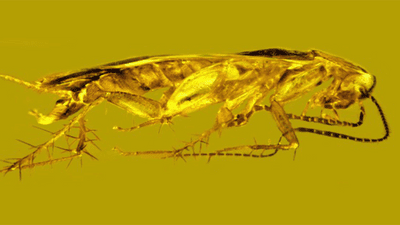


It's been a bumper year for things preserved in amber with snails, flowers, ants, and even a whole group of new insects bursting onto the scene. Now, a new cockroach species has been found encased in amber – and it's even complete with sperm cells. The specimen has been named Supella dominicana as it is surrounded by Dominican amber. This is thought to be the first-ever record of fossilized cockroach sperm.
“It is well preserved with a yellow cross bar across the wings and a central, vertical, yellow stripe that appears to divide the body into two parts,” said George Poinar Jr., professor emeritus in the OSU College of Science who identified the species, in a statement.
"Also of interest is the sperm bundle containing spermatozoa with dark acrosomes, structures covering the head of the sperm, since fossil sperm are rare.”

The specimen is thought to be around 30 million years old and is the only cockroach of the ectobiidae to be discovered in the Dominican Republic. This is unusual because the specimen has no living relations in the Dominican Republic or in the wider West Indies.
Of the 10 species in the genus Supella, nine of them live in the Ethiopian zoogeographical region and one in the Arabian peninsula.

The specimen is 7 millimeters (0.28 inches) in length and originated from an amber mine in the northern mountain range between Puerto Plata and Santiago.
While there are around 4,000 species of cockroaches, only about 30 of these come into contact with people and an even smaller number are regarded as pests. While cockroaches are pretty famous for being indestructible and even being trained for search and rescue, having them in your house can be a real problem, even if you can get paid to let them invade.
“The difficulty in eliminating them from homes once they’ve taken up residence can cause a lot of stress,” Poinar said. “Many might say that the best place for a cockroach is entombed in amber.”
The paper is published in Biologia.

 1
1