Nature
 PUBLISHED
 1
1


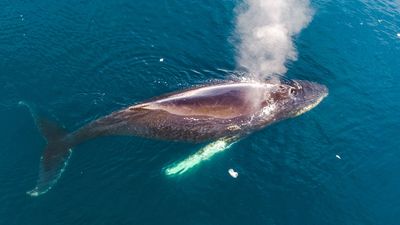


Sadly, a recently rescued humpback whale that had become stranded in Germany in March has now been found dead in Denmark. Although Danish authorities do not yet know the cause of death, there are growing concerns that the animal’s body may imminently explode while it is still too close to land. If you're unsure why a whale may explode or what happens when one does, read on.
The story of the 10-meter (33-foot) young male whale nicknamed “Timmy” caught the German public’s attention back in March 2026 when it became stranded on a sandbar in the Baltic Sea. Its hapless circumstances were first noticed by guests at a hotel in Niendorf in Lübeck Bay, northern Germany, where they could reportedly hear the animal moaning. After the police were notified of its existence, local coastguards, the fire brigade, and marine rescuers set about trying to save it. But Timmy’s condition deteriorated.
German officials eventually gave up on trying to save the whale, believing it could not be rescued from where it was stuck. What followed was a public outcry, which prompted two millionaires to privately fund a mission to free the creature. The decision to allow this to occur was criticized by experts who believed the animal was injured and wouldn't likely survive. Nevertheless, the mission went ahead and involved luring the whale into the water-filled hull of a nearby barge, where it was then transported to the coast of Denmark, an effort that cost around €1.5 million ($1.7 million).
The operation was completed on May 2. But Danish authorities have since confirmed that the whale has died. Its body was found washed ashore on Anholt Island last weekend, just two weeks after the rescue mission.
Timmy’s identity was confirmed after a Danish Nature Agency employee managed to retrieve a tracking device that had been secured to the whale’s back.
"The position and appearance of the device confirm that this is the same whale that had previously been observed and handled in German waters," Jane Hansen, the division head at the Danish Environmental Protection Agency, told AFP in an emailed statement.
Although they know the identity of the animal, it is still unclear what caused Timmy’s death.
The Danish authorities are warning members of the public to avoid the whale’s carcass. Although they understand it is likely a source of interest, it may carry diseases that can be communicated to people. At the same time, there is always the chance that the whale’s body could explode from the gases that are gradually accumulating inside it.
Exploding whales
As unpleasant as it sounds, it is a well-known and gory phenomenon. Basically, as the animals start to decompose, gases produced by bacteria in their organs, including methane, cause their bodies to bloat. But because they have very thick skin and blubber, the gas becomes trapped until it builds up to the point where the animal pops like a large, bloody balloon.
You don't want to be anywhere near that when it happens, hence the decision by the Danish authorities to tow the carcass out to sea. Officials plan to use ropes to drag it further from the coast, to reduce any innocent bystanders from being caught up in an uncontrolled explosion. Not that "controlled" explosions are any better, we'll come to that in a bit.
In 2021, WTF! Outdoors posted a YouTube video showing the explosion of a whale carcass off the California coast, near Tomales Bay. Although it is not clear what species the whale was, the short video shows it erupting into a cloud of viscera. It’s not a pleasant sight, but it is an interesting and important biological phenomenon to understand, though it can be dangerous if people are caught near it.
There have been more recent incidents, too. In 2023, wildlife experts in Ireland abandoned an autopsy of a washed-up whale when they worried it might explode. The dead fin whale had washed up in Baile Uí Chuill Strand, Ballinskelligs, a few weeks before, but after collecting a few samples from its body, the scientists backed off due to fear of an imminent eruption.
The Oregon exploding whale incident of 1970
Although this is a natural outcome for whale bodies, human activities have sometimes helped them with their percussive end. In 1970, an 8-ton sperm whale beached itself on the Oregon coast. Not sure how to get rid of it, the authorities decided to use dynamite to move the carcass in a "controlled" explosion, attempting to aim it back towards the ocean.
Unfortunately, against the advice of a local businessman who had WW2 explosives training and told them they were using too much of the explosive, they went ahead with 20 crates instead of the 20 sticks he suggested. The explosion sent chunks of the animal flying in all directions quite far inland, while leaving the rest of it on the beach.
Apparently, the state has embraced its rather messy past, though. In 2020, it voted to rename a beauty spot, Exploding Whale Memorial Park, as it was the 50th anniversary of the event.