


 Nature
 PUBLISHED


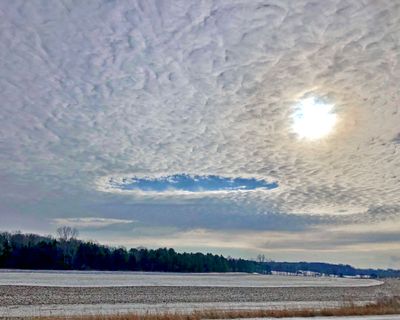


The sheer size of clouds, their deceptively hefty weight, and the threat of getting trapped inside one can make the prospect of giant sky marshmallows pretty terrifying. So, how would you feel seeing one start to sprout what appears to be a giant portal to an alternate dimension?
Fear not, the phenomenon that makes it look as if someone’s taken a giant hole punch to the sky is, in fact, a fallstreak hole or hole-punch cloud. Although not naturally occurring, these gaping holes in cloud cover definitely aren’t anything to worry about.
Appearing as large clearings in altocumulus and cirrocumulus cloud layers, fallstreak holes occur as a result of aircraft passing through the mid-level cloud cover.
Conditions in the clouds hold “supercooled” water droplets at a temperature below 0°C (32°F), but where they’re not yet frozen. As aircraft pass through they bring with them ice crystals, which cause these droplets to expand and cool as they pass over the wings or propellers. This change in temperature is enough to push these supercooled droplets over the edge, causing them to freeze. As they turn into ice crystals, they become too heavy to be held in the cloud, and these now weighty droplets fall out of the sky causing a large gap in the cloud cover.

As a result of the Bergeron process, neighbouring droplets continue to freeze and the hole can carry on expanding for hours after the aircraft has left, leaving behind a large, normally circular or elliptical, shape.
Fallstreak holes aren’t picky, they can be caused by any type of commercial jet aircraft and form pretty frequently throughout the year. The best place to catch a glimpse of one of these holes is, unsurprisingly, at the airport.




 1
1