Nature
 PUBLISHED




The world is undoubtedly filled with all kinds of amazing flowering plant species, from those that only appear once in a blue moon, to those fossilized by time, and the more common well-loved species. Now scientists have described a new species that does something extremely peculiar in the plant world: it flowers underground.
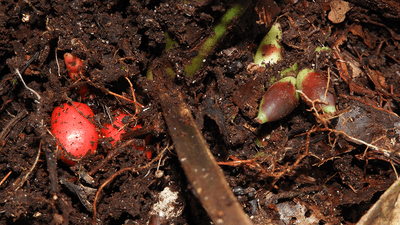
On the tropical island of Borneo, a native plant has been discovered flowering and fruiting under the soil. Known by Indigenous people and valued for its fruit, this new species, named Pinanga subterranea, is the first known species in the palm family to exclusively fruit and flower underground.
Despite the fact that the plant is well known to the local people because of its bright red fruit eaten as a delicacy in some parts of the island, the species has remained unnoticed by scientists – even though they have described over 300 other species of palm on the island.
Dr Paul Chai was the first to notice this species in 1997 in Sarawak, and 20 years later in 2017, Agusti Randi found fruits and remains of the plant, crushed by animals and dug up by pigs, on the forest floor. Palm species number as many as 140 in the genus Pinanga and Borneo is the center of their diversity, so classifying this new species required careful study by Randi, who compared the new specimen to all the known Bornean species.
“Without the tip-off from our Malaysian colleague Dr Paul Chai, we probably would have mistaken this exciting new species for an unremarkable palm seedling and would have walked right past it. Instead, we have scientifically described an incredibly rare case of geoflory, that is underground flowering, and the very first known example of its kind in the entire palm family. It truly is a once-in-a-lifetime discovery,” said Dr Benedikt Kuhnhäuser, Future Leader Fellow at Royal Botanic Gardens (RBG) Kew, in a statement sent to IFLScience.
The processes of plants fruiting and flowering underground, known as geocarpy and geoflory, respectively, have only been seen in 171 plant species. One common example is the peanut, which develops the fruit under the soil after flowering above ground.
To have a plant species that both fruits and flowers underground is extremely rare and has only ever been seen before in the small orchid genus Rhizanthella. These adaptations seem counterproductive in terms of seed dispersal, and this has never been seen before in the palm family, especially since most other members of the genus are pollinated by bee and beetle species.

“I have been studying palms for 30 years and am amazed at how they continue to surprise us. This unexpected find poses many more questions than it answers. What is pollinating the palm? How does the pollinator find the flowers underground? How did this phenomenon evolve and what on Earth will palms surprise us with next?” said Dr William Baker, Senior Research Leader – Tree of Life at RBG Kew in a statement sent to IFLScience.
One suggestion is that the bearded pig (Sus barbatus) is responsible for dispersing the seeds throughout the rainforest, as observations have revealed that the pigs dig up the fruits to consume and could therefore be dispersing the seeds in their feces.

The team conclude that there is still much to discover about these unique species and suggest that this new-to-science discovery highlights the need to more closely collaborate with Indigenous people in the future.
The study is published in Palms (the Journal of the International Palm Society), with an accessible paper describing the species in Plants People Planet.