Nature
 PUBLISHED

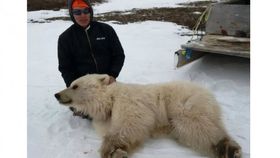


A rare “grolar bear,” a grizzly-polar bear hybrid, has been killed in the frigid upper expanses of Canada. This particularly unfortunate creature wandered into the path of hunter Didji Ishalook earlier this month, who thought it was initially a small polar bear.
“It looks like a polar bear but it’s got brown paws and big claws like a grizzly,” Ishalook told the Guardian. “And the shape of a grizzly head.” Various experts, arriving at the scene of the shooting in Arviat, a small community on the Hudson Bay within the Canadian Arctic, have identified it conclusively as one of the elusive half-breeds.
This grolar bear was accidentally shot as part of a program that legally allows the Inuit to hunt for normal polar bears as sources of food and additional materials. These creatures are actually known as pizzly bears if the father bear is a polar bear, and a grolar if the father is a grizzly; in this case, they can’t be sure which it is, but it’s definitely a rare hybrid regardless.
The recently shot hybrid. NewsBeat Social via YouTube
There are only a handful of these grolar bears in the wild, and it seems they may be increasingly appearing further north thanks to climate change. The Arctic is experiencing accelerated and pronounced warming as of late, and grizzly bears found in Alaska and Canada are moving north to more habitable, colder climates.
This means that they have been coming into contact with coastal polar bears, which are encroaching further inland as the Arctic ice they frequent continues to be diminished. Consequently, with the two distinct species being quite genetically similar, hybrid offspring are appearing more frequently than they used to be.
The grolar bear is a direct consequence of climate change driving natural selection somewhat. It is not unreasonable to think, therefore, that as the world continues to warm, grolar bear numbers may eventually overtake regional polar bear populations, who are arguably more at risk than grizzly bears from rising temperatures.
Some experts, however, have expressed doubt as to whether the grolar will actually be able to thrive in the new, warmer Arctic.
“It is not a good thing for the future of polar bears that we see this hybridization occurring,” Chris Servheen, an expert in bears at the University of Montana, told Vice News. In his opinion, “it's not going to result in some kind of new bear that is successfully living in the Arctic.”