Technology
 PUBLISHED
 1
1


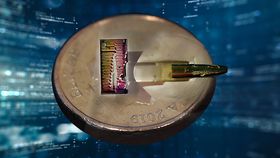


An experimental optical chip developed in a collaboration between Australian universities has recorded the fastest Internet data speed in the world by achieving 44.2 Terabits per second from a single light source. That’s like downloading 1,000 high-definition movies in a fraction of a second.
As reported in Nature Communications, the technology is smaller and lighter than existing telecommunication hardware and was tested on infrastructure already commercially available. Though it will certainly be costly at first, the tech might have a quick turnaround in becoming widely available.
"We're currently getting a sneak peek of how the infrastructure for the Internet will hold up in two to three years' time, due to the unprecedented number of people using the Internet for remote work, socializing, and streaming. It's really showing us that we need to be able to scale the capacity of our Internet connections," co-lead author Dr Bill Corcoran from Monash University said in a statement.
Current technology uses 80 lasers, but the new device doesn’t need them. The optical chip is designed as a “micro-comb” for the light that is transmitted through the fiber. The micro-comb breaks up the light, producing hundreds of laser-like signals and each can be used as its own communication channel.
The test was done on 76.6km of "dark" optical fibers between RMIT University's Melbourne City Campus and Monash University's Clayton Campus. The moniker “dark” here stands for unused. Dark fibers are commonly rented from network service providers.
"Long-term, we hope to create integrated photonic chips that could enable this sort of data rate to be achieved across existing optical fiber links with minimal cost," co-author, and Distinguished Professor at RMIT, Arnan Mitchell, explained.
"Initially, these would be attractive for ultra-high-speed communications between data centers. However, we could imagine this technology becoming sufficiently low cost and compact that it could be deployed for commercial use by the general public in cities across the world."
The team now plans to scale current transmitters to provide faster data without increasing their size, weight, or cost. Their goal is a 100-fold increase in Internet speed from hundreds of gigabits per second towards the tens of terabits per second as demonstrated in their test.