Nature
 PUBLISHED
 1
1


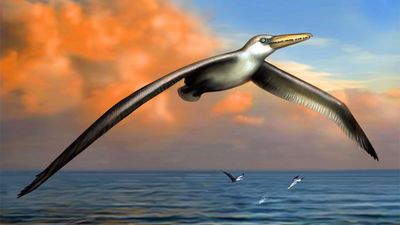


New research on the bird with the largest wingspan ever suggests it didn’t catch fish by skimming across the surface of the ocean – so how exactly did it keep itself fed?
We can all agree birds are terrifying. They are the last surviving dinosaurs after all, and if you’ve ever been dive-bombed by a seagull, you know they haven’t forgotten that fact. None of those alive today hold a candle to Pelagornis sandersi, however, which roamed the skies around 25 million years ago during the Oligocene Period and is proposed to have had a wingspan of around 6.4 meters (21 feet).
To put that into perspective, that’s 1.7 times as large as today’s widest-winged bird, the snowy albatross, or just over half the width of a Cessna 172 light aircraft. Appropriately, the fossil that first revealed this giant to the world was found beneath Charleston International Airport in South Carolina.
P. sandersi was so large, in fact, that researchers initially disagreed over whether it could fly at all, before settling on the idea that it could glide by keeping low to the surface of the water, taking advantage of a phenomenon called the wing-in-ground effect to get a bit of extra lift.
That still leaves the question of what (and how) this massive creature ate. Previously, some researchers proposed that it might have been a skim feeder like modern-day birds in the Rynchops genus, which travel low over the water and submerge their beaks to pick up unsuspecting sea life.
That idea seemed to be supported by Pelagornis’s bizarre pseudoteeth – spiky projections that grow out from its upper and lower beak, making it look particularly nightmarish. Researchers suggested these could have helped ensnare prey as the bird skimmed over the surface of the water, and the arrangement of bones in its jaw and the anatomy of its vertebrae also seemed to point to this possibility.
A new study, however, has thrown a proverbial spanner into this idea by showing that Pelagornis would have experienced an extraordinary amount of hydrodynamic drag if it had attempted to submerge its beak in a similar way to modern-day Rynchops, which skim along with around 19 percent of their bill below the waterline.
The researchers calculated that the massive bird would have been subject to a nine-fold increase in drag under this scenario, making the whole maneuver far too energetically taxing to sustain, and pushing the bird’s required energy output above the theoretical maximum it could produce. The math, as they say, ain’t mathing.
Pelagornis is fascinating because its unusual anatomy raises long‑standing questions about how such giant birds lived.
Olivia Hellyer-Price, Chris Venditti, and Stuart Humphries
This even held true when they modeled the submersion of smaller fractions of the beak, such as 5 percent. This is similar to what is seen in frigatebirds, which are known to pluck fish from the water’s surface rather than skim.
"Our study shows that Pelagornis – despite being one of the largest flying birds ever – could not have met the enormous energetic costs required to skim-feed, or even to pick prey from the water surface while staying airborne," study authors Olivia Hellyer-Price, Chris Venditti, and Stuart Humphries told IFLScience.
That said, they couldn’t entirely rule out some form of beak-dipping behavior, as it is possible for birds to produce more than their maximum metabolic output over short periods during specialized maneuvers. It is just difficult to determine from fossil evidence alone whether this would have been possible for Pelagornis.
Regardless, the physics of both scenarios doesn’t appear particularly favorable, and it seems like the huge bird would have been walking an energetic tightrope if it tried either method of catching fish. So, supposing Pelagornis didn’t skim for food or pluck it from the water’s surface, how might it have caught its prey?
Perhaps it stole it from other birds, a behavior known as kleptoparasitism, or raided their nests. Alternatively, it may have taken on a more predatory role and snatched smaller birds out of the air before gobbling them up. The jury is still out.
"For us, Pelagornis is fascinating because its unusual anatomy raises long‑standing questions about how such giant birds lived, and biomechanical modelling lets us test these ideas in ways the fossil record alone cannot," said the researchers. "More broadly, studies like this demonstrate how modern engineering approaches can reveal the behaviours and ecological roles of extinct species."
The study is published in Royal Society Open Science.