Nature
 PUBLISHED



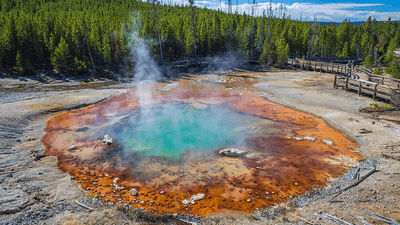


The world's largest acidic geyser has erupted for the first time in years at Yellowstone National Park. The Echinus Geyser, which consistently put on a show in the last half of the 20th Century, last erupted in 2020.
Despite worryingly-regular incidents of visitors falling into acidic water, these are actually the rarest type of geyser around the world and at Yellowstone.
"Many visitors to Yellowstone believe that all of the hot springs in the park are acidic (pH lower than 5), and that the water will cause an acid burn on contact and dissolve any animals or people that fall into the springs," the United States Geological Survey (USGS) explains.
"But nearly all major hot springs and geysers in Yellowstone are actually neutral (pH of around 7) or alkaline (pH greater than 7), including almost all of the geysers and hot springs in the famous thermal basins along the Firehole River."
So what makes these geysers so rare? As the National Parks Service puts it, they "eat away at their own plumbing systems", with the acidic water breaking down the surrounding rock.
"At Echinus Geyser, however, the composition is due to mixing between acidic gases and neutral waters, and the acidity is not sufficient to eat away at the rock," the USGS explains in an update following the latest eruption.
"The somewhat unique water chemistry results in interesting formations and compositions, including the red color (from iron, aluminum, and arsenic) that rims the geyser pool and the silica-covered spiny rocks that give the geyser its name."
Echinus is thought to have been largely dormant before 1948, erupting only occasionally. But by the 1970s it was erupting every 40–80-minutes, and the eruptions increased in intensity throughout the 80s and 90s. Some could reach 23 meters (75 feet) into the air.
But in recent years, it hasn't been quite so active. From 2010 there were a few eruptions here and there, before a burst of activity in October and November 2017, when eruptions happened roughly every 2–3 hours. Then the activity came to an abrupt end, and there was only one eruption each in 2018 and 2019, and two in 2020. From then until 2026, the geyser – measuring around 20 meters (66 feet) across – went quiet again, with no eruptions at all.
In February, it began erupting once more. After eruptions on February 7, 9, 12, and 15, the frequency picked up to once every 2–5 hours, reaching heights of about 6–10 meters (20–30 feet). According to the USGS, the activity resembles what happened in 2017.
Unfortunately, the USGS says that the eruptions will probably not last for too long. In fact, there were no eruptions during the last few days of February, suggesting the burst of activity may already be over.
"But change is constant at Norris Geyser Basin," they add, "so perhaps the show will continue into the summer."