Ad

space-iconSpace and Physicsspace-iconAstronomy
clock-iconPUBLISHEDSeptember 18, 2024
comments icon2
share44

Earth Photobombs Phobos In Incredible View From Mars

NASA’s Curiosity spotted a close encounter between the moon and our planet.

Dr. Alfredo Carpineti headshot

Dr. Alfredo Carpineti

Alfredo has a PhD in Astrophysics and a Master's in Quantum Fields and Fundamental Forces from Imperial College London.

Space & Physics Editor

Alfredo has a PhD in Astrophysics and a Master's in Quantum Fields and Fundamental Forces from Imperial College London.View full profile

Alfredo has a PhD in Astrophysics and a Master's in Quantum Fields and Fundamental Forces from Imperial College London.

View full profile
EditedbyLaura Simmons
Laura Simmons headshot

Laura Simmons

Health & Medicine Editor

Laura holds a Master's in Experimental Neuroscience and a Bachelor's in Biology from Imperial College London. Her areas of expertise include health, medicine, psychology, and neuroscience.

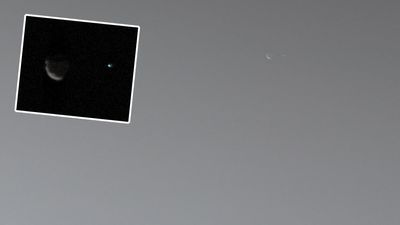
The image of phobos as a crescent with a dot next to it which is the Earth. A zoomed in inset show the same with more details of phobos showing its potato shape.

Earth and Phobos from Mars. You can see easily how across the gulf of space, intellects vast and cool and unsympathetic would regard this Earth with envious eyes...

Image credit: NASA/JPL-Caltech/MSSS


In an out-of-this-world first, Earth and Phobos have been photographed together in the sky by NASA’s Curiosity. The rover has previously snapped this moon and its companion Deimos, including in a beautiful eclipse, something also seen by Curiosity’s sibling Perseverance. The rover has also seen the Earth in the Martian sky, a bright dot like Venus is to us. But Phobos and Earth have never appeared together.

The stunning image was taken by the rover’s MastCam. It takes color images and videos of the terrain, but it has also been used to snap the sky above the Red Planet. The image was made of five short exposures and 12 longer ones on September 5. That was the 4,295th Martian day that Curiosity has spent on Mars.

a mound is in the foreground of this thin but long phoot. On the tob a cresent is seen that is phobos. next to hit a bright dot can be spotted
The rough terrain of Mount Sharp, and above in the sky, Earth setting as Phobos rises.
Image credit: NASA/JPL-Caltech/MSSS

Phobos is very unlike our own Moon. First of all, it is tiny. It’s just 22.2 kilometers (13.8 miles) across. To add to the list of peculiarities, it is also very close to Mars. Actually, Phobos is the closest orbiting moon in the Solar System. It goes around Mars in just seven hours at a distance of just 9,000 kilometers (5,600 miles). It is also shaped like a potato, it has one giant crater and a strange chain of craters across its surface, and – along with Deimos – may have been part of a larger moon or a chunk of the Red Planet itself.

It is believed that Phobos, or part of it, might in the future crash into Mars, so this picture shows a doomed moon and our precious pale blue dot.


Add us as a Google preferred source to see more of our
trusted coverage in Search