Space and Physics
 PUBLISHED




What if we tell you that researchers have found something interstellar buried in the ice in Antarctica? One possibility is the plot of The Thing; the other is a mystery that has puzzled scientists for a while – the presence of a rare type of iron that is formed in supernovae and should not be on the surface of the ice. How did it get there if there have not been any recent supernovae nearby? We finally have an answer.
The element in question is called iron-60 and is produced in supernovae, the explosive death of massive stars. Most iron around us (and in us) is iron-56, which has 26 protons in its nucleus and 30 neutrons. Iron-60 is an isotope of iron with 34 neutrons instead. It has a half-life of 2.6 million years, and there are only traces of it around in nature.
Geological records reveal the times when supernova material has reached Earth in the last several million years. So, it was surprising that a few years back, scientists found iron-60 in surface snow in Antarctica that was less than two decades old. We would have noticed a supernova going off so recently and so closely that its material was slamming down on Earth.
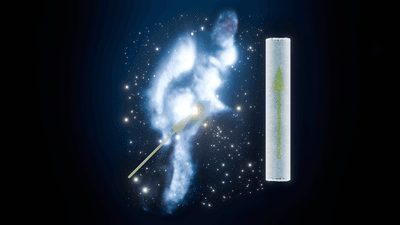
Clearly, it was coming from somewhere. The team suspected that it had to do with the Local Interstellar Cloud (LIC), a dusty region in space that the Solar System is currently moving through. To confirm its origin, the team had to perform some time traveling.
“Our idea was that the Local Interstellar Cloud contains iron-60 and can store it over long time periods. As the Solar System moves through the cloud, Earth could collect this material. However, we couldn’t prove this at the time,” lead author Dr Dominik Koll from the Institute of Ion Beam Physics and Materials Research at Helmholtz-Zentrum Dresden-Rossendorf said in a statement.
Without a TARDIS or a DeLorean, researchers got samples of deep-sea sediments up to 30,000 years old, as well as samples of ice cores dating back 40,000 and 80,000 years. They found that the iron-60 signals change over tens of thousands of years, consistent with the motion of the Solar System across the Local Interstellar Cloud. This suggests that the LIC can keep hold of supernova-produced material for quite some time.
“This means that the clouds surrounding the Solar System are linked to a stellar explosion. And for the first time, this gives us the opportunity to investigate the origin of these clouds,” added Koll.
To find these iron-60 atoms, the team started with 300 kilograms of ice, chemically processing it to hunt out the interesting metals. Out of an initial 10 trillion atoms of the process sample, only a handful were iron-60.
“It’s like searching for a needle in 50,000 football stadiums filled to the roof with hay. The machine finds the needle in an hour,” explained co-author Annabel Rolofs from the University of Bonn.
“Through many years of collaboration with international colleagues, we have developed an extremely sensitive method that now allows us to detect the clear signature of cosmic explosions that occurred millions of years ago in geological archives today,” summarized Prof. Anton Wallner.
The study is published in the journal Physical Review Letters.