Humans
 PUBLISHED





An Ice Age cave in Europe, strewn with mammoth furs and rock art of woolly rhinos, is the archetypal setting for a Neanderthal in most people's imaginations. However, could some of them have been desert-dwellers instead?
Neanderthals are known to have lived around 400,000 to 40,000 years ago throughout Europe and western Asia. This range stretched from the west coast of the Iberian Peninsula to the Altai Mountains in southern Siberia, and across to the Zagros Mountains of modern-day Iran.
But in a new study, archeologists suggest that they might have also lived in a significant portion of northern Arabia, a territory more closely associated with their close relatives and our own species, Homo sapiens.
Neanderthals in the desert
The recent evidence is not in the form of fossilized bones or DNA. Instead, the team compared the shape of prehistoric stone tools discovered around northeast Africa, Arabia, and the Middle East.
Known as Levallois blanks, some of the tools in these collections have been attributed to Neanderthals, while others appear to be the work of Homo sapiens.
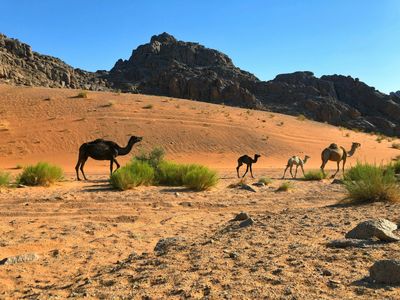
The researchers were especially struck by the stone tools found at a site called Jebel Katefeh-1 (JKF-1), located by a dried-up prehistoric lake near the city of Jubbah in northern Saudi Arabia's Nefud Desert. The artifacts found have long been a source of confusion for researchers since the style doesn't match other Arabian sites.
To figure out why the stone tools at JKF-1 appear different, the team used a statistical model that looked at the different attributes of the tools and the archeological setting, including the site's age, the environmental conditions at the time, the raw material used, and the size of the collection.
This data was used to train a model that could distinguish the handiwork of Neanderthals and Homo sapiens with up to 93 percent accuracy.
When they plugged the details of the JKF-1 tools into the model, the results were surprising. They suggest that it was Neanderthals — and not Homo sapiens — who were the toolmakers at Jebel Katefeh.
A more recent and accurate dating of the JKF-1 site might be key to understanding how this came to be.
The researchers explain that the tools were dated to around 55,000 years ago, during a relatively humid spell within a broader cold period. This window of time is later than the wetter "Green Arabia" interglacial phases usually linked to Homo sapiens successful dispersals out of Africa.
This timing fits with a period in which Neanderthals are known to have expanded their range within the Middle East between 75,000 and 50,000 years ago. This new study suggests that they may have kept moving south into northern Arabia.
These findings are far from definitive. The paper itself is titled "Neanderthals in the desert?...". With a question mark like that, you know there's some uncertainty.
To say with confidence that Neanderthals were in this now-arid part of western Asia, archeologists would ideally unearth fossilized bones or genetic evidence. Nevertheless, the study does fit into an emerging narrative that suggests Europe was not the primary home of Neanderthals and, in fact, their range across Asia was much more extensive than older theories held.
As the paper explains, “Despite over a century of intensive study, there remains much to be learned about the Neanderthals. A research bias towards western Europe continues to influence perceptions of the species, while conversely a gaze towards Africa shapes interpretations of Arabian prehistory.”
As archeologists make more discoveries and develop sharper techniques to analyze those finds, don’t be surprised to hear more and more about Neanderthals popping up in unexpected pockets of Eurasia.
The new study is published in the journal Quaternary Science Reviews.


 1
1