Space and Physics
 PUBLISHED



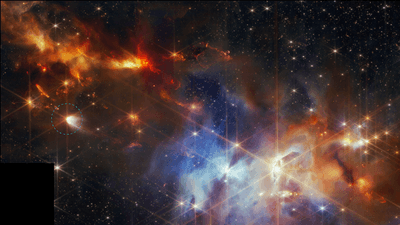


The presence of crystalline silicates in comets has been a long-standing conundrum. These minerals need intense heat to form, but comets are assembled under the icy conditions of star systems' outskirts. How can these opposing requirements be met? Researchers have just found how in new observations of protostar EC 53.
EC 53 is located in the Serpens Nebula, about 1,300 light-years from Earth. It is not a fully fledged star, undergoing quiet and more active phases, the bursts. Every 18 months, the protostar has 100 days of intense activity. The bursts in particular affect the protoplanetary disk of material that surrounds this object, and it’s there that JWST came in.
Thanks to the space telescope's incredible infrared observations, researchers were able to study what’s happening in the disk. They saw the formation of common silicate materials in the hot inner portion of the disk, and that powerful winds from the star are throwing the crystals towards the outer edges of the disk.
“EC 53’s layered outflows may lift up these newly formed crystalline silicates and transfer them outward, like they’re on a cosmic highway,” lead author Jeong-Eun Lee, professor at Seoul National University in South Korea, said in a statement.
“Even as a scientist, it is amazing to me that we can find specific silicates in space, including forsterite and enstatite near EC 53,” added Doug Johnstone, a co-author and a principal research officer at the National Research Council of Canada. “These are common minerals on Earth. The main ingredient of our planet is silicate.”
The system has been studied for decades, but JWST was able to show where the silicates are before and after a burst. The previous uncertainty on how silicates got into the comet and at the colder edges of the protoplanetary system is dissipating. The observations provide a mechanism for how that can happen.
“Our research team mapped how the crystals move throughout the system. We’ve effectively shown how the star creates and distributes these superfine particles, which are each significantly smaller than a grain of sand,” Joel Green, a co-author and an instrument scientist at the Space Telescope Science Institute in Baltimore, Maryland.
EC 53 will continue to be cocooned by dust for another 100,000 years. If we could speed up time, we would see that the crystals formed by the stellar heat will eventually be grains, which will turn into pebbles, and through many collisions, into planets. And now we have a better understanding of some of those crucial steps at the early stages of planetary formation.
The results were published in a paper in the journal Nature.