Humans
 PUBLISHED
 1
1




At the appropriately named "Corpse Point" in the Svalbard archipelago in the Arctic Ocean, the permafrost is melting, revealing the damaged remains of people buried there in the 17th and 18th centuries.
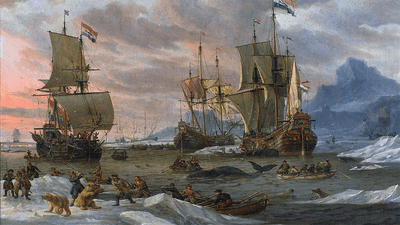
In 1596, Dutch explorer Willem Barentsz first caught sight of Spitsbergen, on the archipelago now known as Svalbard. By that time, humanity had already developed a significant hankering for hunting whales, with their blubber being valued for use as lamp oil and as an industrial lubricant, not to mention that precious ambergris they store inside them.
It was soon found that Svalbard was full of these magnificent animals / blubber storage devices, depending on your attitude to the whaling industry, which admittedly may be a product of your position in time.
"It is only through the lens of hindsight that the whaleman’s job becomes malicious or cruel," author Richard Ellis wrote in Men and Whales, a look at the history of the tumultuous relationship between humans and whales. "Oil was needed for light and lubrication; baleen was needed for skirt hoops and corset stays. That whales had to die to provide these things is a fact of seventeenth, eighteenth, and nineteenth-century life."
Systematic whaling in the region began in 1612, and by the middle of the century whales learned to avoid the coastal areas, and the strange land monkeys who seemed pretty determined to crack open their guts. Humans adapted too, and began capturing and killing whales on the open sea, rendering the blubber on board or waiting for their return to shore.
"Whaling really took off at this point. Soon whaling was practiced in much [of] the northern seas, attracting ships from most of Europe’s seafaring nations," the Svalbard Museum explains. "Many more than previously participated in whaling. At the end of the 17th century, as many as two or three hundred whaling and sealing vessels could be out in the ice east of Greenland in the summer."
Dutch whalers had a delightful habit of naming things very literally. For instance, there was "Smeerenburg" established in 1619 for whaling purposes, which literally meant "Blubber Town". In the northwestern coast of Spitsbergen, the largest island in the Svalbard archipelago, there is an area known as "Likneset" or "Corpse Point", where the remains of many whalers were laid to what turned out to be semi-permanent rest.
Due to the ongoing climate crisis, the area has lately been revealing a lot of these corpses to the world once more. Whilst a pretty grim thing to behold, it has allowed Lise Loktu of the Norwegian Institute for Cultural Heritage Research, and Elin Therese Brødholt of Oslo University Hospital in Norway, an opportunity to investigate the short and arduous lives of humans who traveled to the Arctic Circle in search of a better life, and blubber.
Analyzing the skeletal remains, found in a range of preservation states, the team found that they were all biologically male, largely around 20-25 at the times of their deaths, and riddled with disease before they went on their way.
"Scurvy represents the most pervasive metabolic condition in the Likneset assemblage, with skeletal indicators consistent with vitamin C deficiency recorded in 18 of 19 individuals," the team explains in their paper. "Lesions are dominated by periarticular and subperiosteal changes affecting the long bones, most frequently the femora, tibiae, fibulae, and humeri, while cranial involvement is rare."
Scurvy, caused by a long-term deficit of vitamin C, is a particularly nasty disease, causing bleeding gums, fatigue, as well as old wounds and scar tissue to reopen and begin bleeding again. It was far from the young whalers' only problems, with examinations of their teeth and bones revealing rickets in at least one individual, and signs of severe malnutrition during childhood.
The work, as shown in the bones of the whalers studied, was tough on the body. Eighteen of the 19 individuals studied showed signs of degenerative joint disease (DJD) or osteoarthritis, now largely found in far older humans.
"The upper body is most consistently involved," the team adds. "Degenerative and activity-related changes affecting the shoulders, clavicles, sternum, and elbows are documented in most individuals, particularly in the humeri, scapulae, clavicles, and sternum."
Identifying several healed injuries in the whalers, including healed fractures and spinal injuries, the team suggests that the whalers' deaths were largely likely not the result of single, traumatic events, but an accumulation of long physiological stress, even at such young ages.
"These skeletons show us the human cost of Europe’s first oil industry. As permafrost thaws and coastal erosion accelerates, we are losing entire archives of human lives that can never be replaced. We are not only losing landscapes, but also the human stories preserved within them," the authors added in a statement.
“What we are seeing in these skeletons is the physical imprint of one of Europe’s first global industries. We can see how labour, diet, disease, and mobility left physical traces in the people who took part in early Arctic whaling. Many of these men died very young, yet already show clear signs of heavy physical strain, disease, and nutritional stress.”
Though much was learned from these remains, exposed from the 1980s and into the 2010s, perhaps more importantly the team found that the climate crisis is erasing this record of the earliest large-scale European extractive industries in the High Arctic.
"Rapid Arctic warming is accelerating the degradation of permafrost-preserved archaeological sites, threatening both cultural heritage and the scientific information it contains. Early modern whaling burial sites on Svalbard are particularly vulnerable due to their organic-rich burial contexts and exposed coastal settings," the team writes in their paper, adding:
"The results highlight growing challenges for heritage management on Svalbard, where strategies based on in situ preservation and managed decay are increasingly strained under warming permafrost conditions, underscoring the need for systematic monitoring, targeted documentation, and integration of archaeological data into climate adaptation planning before irreplaceable archives are lost."
The study is published in PLOS One.